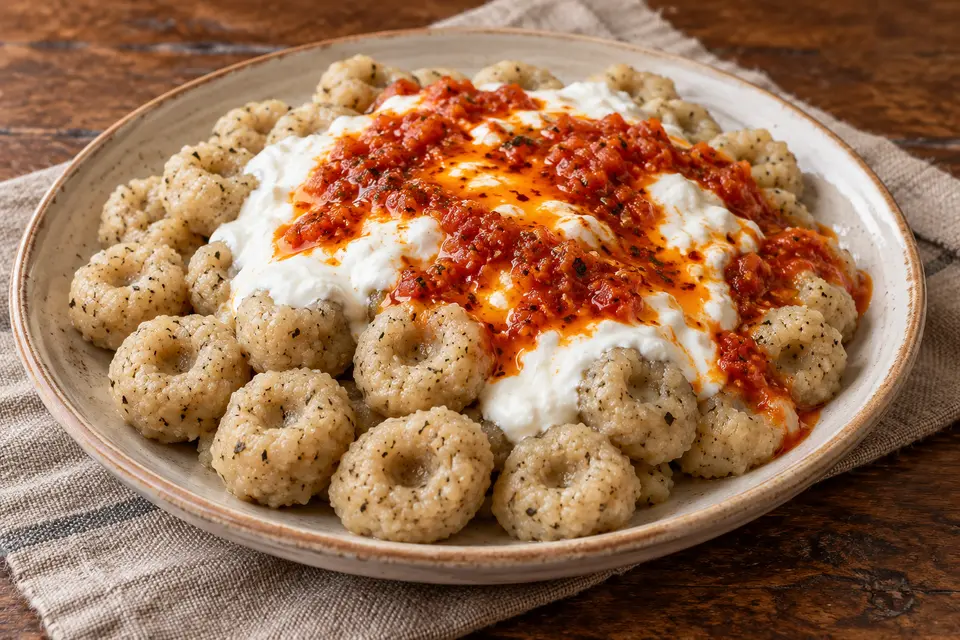
The provincial culture and tourism authority records Göce Köftesi as a dish specific to Afyon cuisine and notes its local name, Göce Köttüsü. Göce is hulled wheat that is cracked and sieved; the finer portion is used for these dumplings, while a very fine bulgur called düğü forms the other half of the grain mixture. This version preserves that two-grain structure, the thumb-pressed button shape and the official yogurt-and-tomato finish.
Göce Köftesi — Recipe Card
Afyon Cracked-Wheat Dumplings with Garlic Yogurt
Makes 6 servings · Makes about 48 small button-shaped dumplings, serving 6.US cup = 240 ml · tablespoon = 15 ml · teaspoon = 5 ml. Cup and weight conversions are approximate. Australian cooks: use a 15 ml measuring tablespoon.
Ingredient quantities and servings are scaled. Cooking times, pan sizes, frying oil depth, and temperatures stay the same; cook larger batches as needed.
Ingredients
How to make Göce Köftesi
Soak the grains
Combine the fine bulgur, göce, dried mint and salt in a wide bowl. Pour over all 360 ml (1 1/2 cups) boiling water, stir once, cover and leave for 20 minutes. The grains should be swollen and warm, with no standing water.
Mix the garlic yogurt
Stir the strained yogurt and grated garlic together until smooth. Cover and refrigerate while you make the dumplings so the topping stays cold.
Knead the dumpling mixture
Add the lightly squeezed grated onion, egg and flour to the soaked grains. Knead firmly by hand for 6 to 8 minutes, until the mixture is cohesive and a pinched piece holds together without cracking. Do not taste the raw mixture.
Shape the buttons
Keep a small bowl of water beside you and dampen your hands lightly. Roll the mixture into about 48 marble-sized balls. Press a shallow dimple into the centre of each with your fingertip, keeping the base intact, and arrange them on a tray.
Boil the dumplings
Bring 2.5 litres (10 1/2 cups) water to a steady boil in a wide pot. Add the dumplings in two batches so they can move freely. Lower to a lively simmer and cook for 8 to 10 minutes; once they float, give them another 3 to 4 minutes. The centres should be fully set and reach 71°C (160°F). Lift out with a slotted spoon and drain well.
Cook the tomato-butter sauce
While the dumplings boil, melt the butter in a small pan over medium heat. Add the grated tomato and cook for 6 to 8 minutes, stirring, until thick and glossy. Stir in the pul biber for the final 30 seconds, then remove from the heat.
Layer and serve
Arrange the hot drained dumplings on a shallow serving plate. Spoon the cold garlic yogurt over them, then finish with the warm tomato-butter sauce. Serve immediately while the dumplings are tender.
Bring this recipe to your kitchen with a printable copy.
Print recipeRecipe from MyTurkishRecipes · https://myturkishrecipes.com/turkish-cracked-wheat-dumplings-goce-koftesi. Quantities reflect your selected serving scale. Cooking times are estimates; follow the doneness cues.
Make it work in your kitchen
Ingredient Substitutions
These swaps change flavor or texture as described. Keep the original ingredients for the closest version of the dish.
Pul biber
Use the same amount of mild paprika for color and a gentler flavor. For heat, add a small pinch of chili flakes, then taste; chili flakes can be much hotter.
Fine bulgur
Look for fine bulgur labelled köftelik or #1. Coarse pilaf bulgur needs different hydration and cooking; do not replace it directly in this recipe.
A few helpful kitchen notes
Düğü and göce
Düğü is the finest grade of bulgur; look for fine or köftelik bulgur. Göce is hulled, cracked wheat rather than bulgur. Turkish grocers may label it göce, yarma or cracked aşure wheat. Keep the two grains distinct for the intended texture.
Heat level
Medium with 1 teaspoon pul biber, although brands vary. Use 1/2 teaspoon mild pul biber for a gentler sauce, or 1 1/2 teaspoons hot pul biber for more heat.
Dietary notes
Vegetarian as written. The dish contains wheat and gluten, egg and dairy. A gluten-free label or substitution is not appropriate because bulgur, göce and flour build the dumpling's structure.
Food safety
Wash hands and utensils after handling the raw egg mixture, do not taste it before boiling, and cook the centres to 71°C (160°F). Refrigerate leftovers within 2 hours.
How to store and reheat Göce Köftesi
For best texture, refrigerate the boiled dumplings, garlic yogurt and tomato-butter sauce in separate covered containers within 2 hours. Keep at 4°C (40°F) or below for up to 3 days. Reheat only the dumplings and tomato sauce to 74°C (165°F), then add the cold yogurt; do not freeze the yogurt topping.
Göce Köftesi: questions and answers
What are düğü and göce?
Düğü is very fine bulgur left after sieving, while göce is hulled wheat that has been cracked. They are different products and together give Göce Köftesi its tender but grainy bite.
Why are my dumplings falling apart?
The grains may be under-hydrated or the mixture may need more kneading. Knead until a test piece seals smoothly, keep the dumplings small and lower them into steadily boiling water without crowding the pot.
Can I shape Göce Köftesi ahead?
Yes. Arrange the shaped raw dumplings in one layer, cover and refrigerate for up to 4 hours. Boil them directly from the refrigerator and confirm that the centres reach 71°C (160°F).