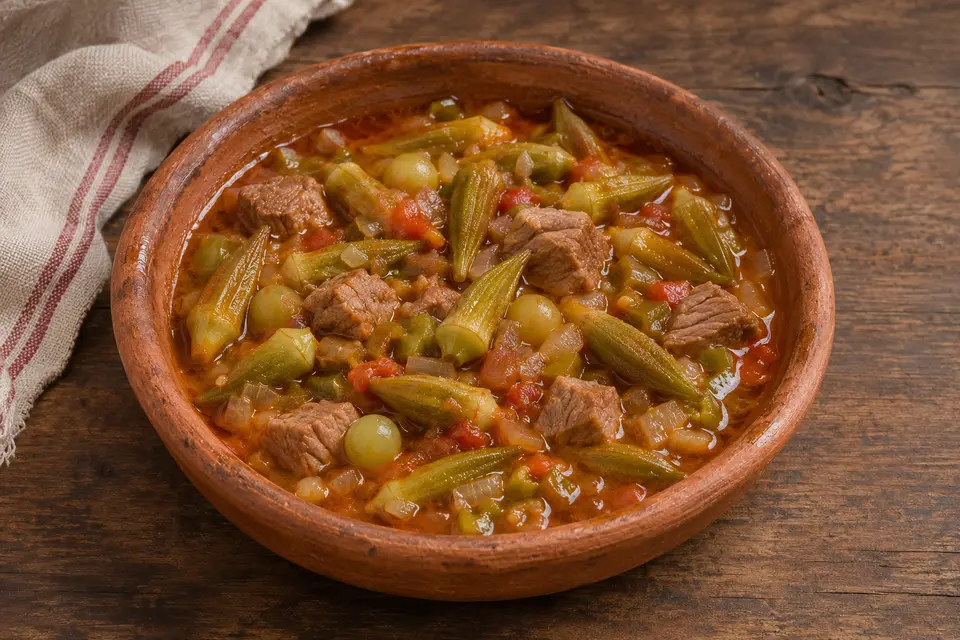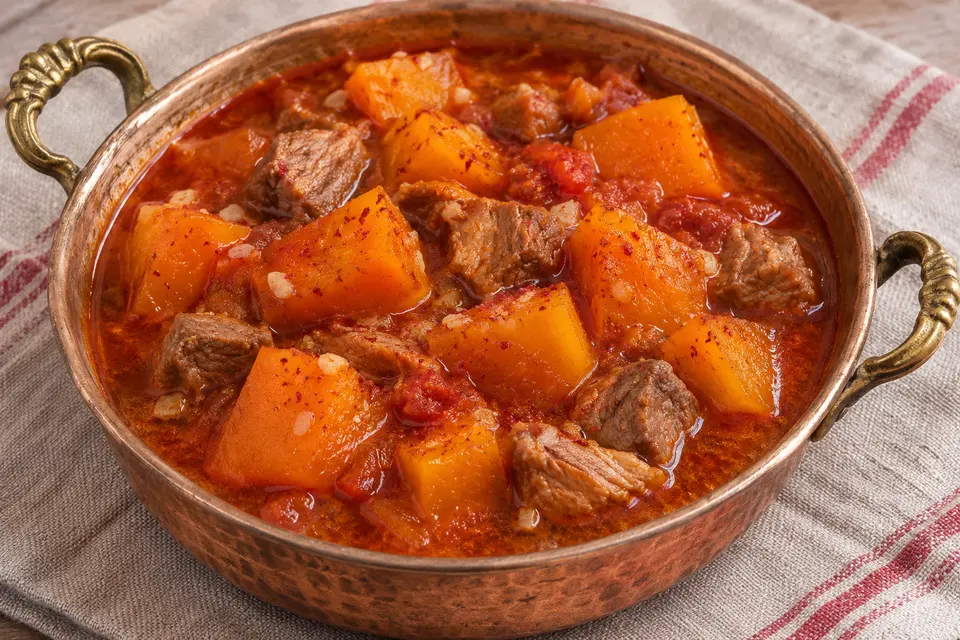
Registered as geographical indication No. 855 in 2021, Diyarbakır Kabak Meftunesi traditionally uses lamb from the Karakaş sheep breed, Cucurbita moschata winter squash and local sumac. Its defining method steeps whole sumac in three measures of water, strains the tart liquid into the stew and finishes the cooked dish with crushed garlic.
Diyarbakır Kabak Meftunesi — Recipe Card
Lamb and Winter Squash Stew with Sumac
Makes 6 servings · Serves 6 as a main dish, with generous pieces of lamb and winter squash.US cup = 240 ml · tablespoon = 15 ml · teaspoon = 5 ml. Cup and weight conversions are approximate. Australian cooks: use a 15 ml measuring tablespoon.
Ingredient quantities and servings are scaled. Cooking times, pan sizes, frying oil depth, and temperatures stay the same; cook larger batches as needed.
Ingredients
How to make Diyarbakır Kabak Meftunesi
Steep the whole sumac
Put the whole sumac berries in a heatproof bowl and pour over 720 ml/3 cups hot water. Cover and steep for 30 minutes so the liquid becomes deep red and tart.
Strain without grit
Pour the infusion through a fine sieve lined with damp cheesecloth or a coffee filter. Press gently, then discard the berries. Keep the clear sumac liquid ready.
Brown the lamb
Pat the lamb dry and season with the salt; do not wash raw meat. Melt the clarified butter in a wide heavy pot over medium-high heat. Brown the lamb for 6–8 minutes, turning so several sides color.
Build the red base
Lower the heat to medium. Add the tomato paste and pul biber and stir for 1 minute, just until the paste darkens slightly and smells fragrant.
Add squash and sumac liquid
Set the large squash cubes over the lamb. Pour in the strained sumac liquid and only enough additional hot water to barely cover the ingredients, up to 240 ml/1 cup.
Simmer gently
Bring to a gentle simmer, cover partially and cook for 40–50 minutes. Turn the pieces once or twice with a broad spoon; stop when the lamb is fork-tender and at least 63°C/145°F, while the squash still holds its shape.
Finish with garlic and rest
Remove the pot from the heat, fold in the crushed garlic without mashing the squash, cover and rest for 10 minutes. Serve hot with some of the tangy red broth in each bowl.
Bring this recipe to your kitchen with a printable copy.
Print recipeRecipe from MyTurkishRecipes · https://myturkishrecipes.com/turkish-lamb-and-winter-squash-stew-diyarbakir-kabak-meftunesi. Quantities reflect your selected serving scale. Cooking times are estimates; follow the doneness cues.
Make it work in your kitchen
Ingredient Substitutions
These swaps change flavor or texture as described. Keep the original ingredients for the closest version of the dish.
Pul biber
Use the same amount of mild paprika for color and a gentler flavor. For heat, add a small pinch of chili flakes, then taste; chili flakes can be much hotter.
A few helpful kitchen notes
Registered proportions
The registration specifies 1.5 kg winter squash, 500 g lamb, 2 tablespoons clarified butter, 1 tablespoon tomato paste, 1 cup whole sumac, 4–5 garlic cloves, salt and pul biber for six people.
Sumac matters
Use whole dried sumac berries for the infusion. Ground culinary sumac clouds the broth and cannot be strained as cleanly; bottled lemon juice does not reproduce the registered method.
Squash choice
Butternut is a widely available Cucurbita moschata substitute for Diyarbakır winter squash. Cut it large and avoid very soft canned or frozen squash.
Heat level
Medium. The base uses 6 g pul biber. For a milder variation use 2 g; for a hotter pot use up to 9 g without changing the sumac or garlic.
Dietary
The listed ingredients are gluten-free when the tomato paste is specifically labelled gluten-free. This is not a certification and no claim is made about cross-contact or suitability for coeliac disease.
Food safety
Keep raw lamb and its utensils away from the squash and finished food. Cook the lamb to at least 63°C/145°F and a 3-minute rest; the longer braise should also make it fork-tender.
How to store and reheat Diyarbakır Kabak Meftunesi
Refrigerate the stew within 2 hours in shallow covered containers at 4°C/40°F or below. Use within 3 days. Reheat gently on the stovetop, adding a splash of water if needed, until the lamb and broth reach 74°C/165°F throughout. Freeze for up to 2 months; thaw overnight in the refrigerator.
Diyarbakır Kabak Meftunesi: questions and answers
What is meftune?
Meftune is a family of tangy Diyarbakır dishes. This registered version pairs lamb and winter squash with a strained whole-sumac infusion.
Can I use ground sumac?
Whole berries are strongly preferred because the registration steeps and strains them. Ground sumac leaves sediment and gives a different broth texture.
Can I replace the lamb?
Lamb is part of the registered identity. Beef chuck can follow the same practical method, but the result should be described as a variation rather than Diyarbakır Kabak Meftunesi.
Why add garlic at the end?
The late addition is characteristic of the registered method and keeps the garlic aroma fresh during the covered rest.