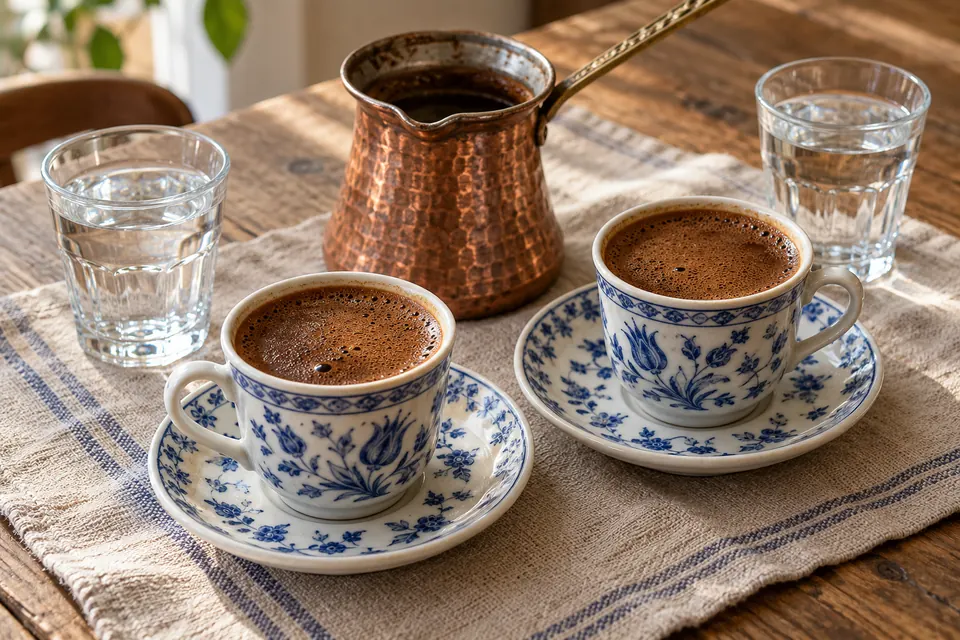
Serving Turkish coffee is closely connected with hospitality and conversation. Its culture and tradition were inscribed on UNESCO's Representative List of the Intangible Cultural Heritage of Humanity in 2013. Brewing details and preferred sweetness vary; this stovetop version uses a cezve, a powder-fine grind and two gentle rises, without a prolonged rolling boil.
Türk Kahvesi — Recipe Card
Unfiltered Turkish coffee brewed slowly in a cezve
Makes 2 servings · Makes 2 small coffees, roughly 60–70 ml each after brewing. Use two cups of about 90 ml capacity so there is room below the rim.US cup = 240 ml · tablespoon = 15 ml · teaspoon = 5 ml. Cup and weight conversions are approximate. Australian cooks: use a 15 ml measuring tablespoon.
Ingredient quantities and servings are scaled. Cooking times, pan sizes, frying oil depth, and temperatures stay the same; cook larger batches as needed.
Ingredients
How to make Türk Kahvesi
Measure and mix
Use a clean cezve sized for two small coffees, about 250–300 ml (8½–10 fl oz) capacity, leaving plenty of room for the foam to rise. Put in all the coffee and water. If using sugar, add the chosen amount from the notes now. Stir thoroughly before heating, until the grounds are evenly wet.
Heat slowly
Set over low heat with the handle safely away from the flame or hot ring. Do not stir again. Heat for about 3–5 minutes, watching for fine bubbles and a layer of foam that begins to lift. Timing depends on your stove and pot; do not wait for a vigorous boil.
Share the first foam
As the foam rises, take the cezve off the heat before it reaches the rim. Spoon a little foam into each cup, sharing it as evenly as possible. Keep the pot upright and take care: the coffee and metal are very hot.
Finish gently
Return the cezve to low heat just until the surface starts to rise again, usually another 10–30 seconds. Remove immediately; do not keep it at a rolling boil. Pour slowly into the two cups, alternating between them to divide the liquid evenly without disrupting the foam.
Let settle and serve
Wait about 1 minute for the sediment to settle and the coffee to cool slightly. Serve with drinking water alongside. Sip slowly, leaving the thick grounds at the bottom of the cup; do not stir them back into the drink.
Bring this recipe to your kitchen with a printable copy.
Print recipeRecipe from MyTurkishRecipes · https://myturkishrecipes.com/turkish-coffee-recipe-turk-kahvesi. Quantities reflect your selected serving scale. Cooking times are estimates; follow the doneness cues.
A few helpful kitchen notes
Sweetness
The base recipe is sade, with no sugar. For two lightly sweet coffees, add 4 g (1 tsp) granulated sugar to the cezve before heating; for medium sweetness, use 8 g (2 tsp). These are practical starting points, not fixed rules for every household. Brew separate pots for different sweetness preferences.
Grind and equipment
Use coffee ground to a powder specifically for Turkish coffee. Ordinary filter or espresso grinds do not give the same texture. A small narrow-topped cezve offers better control than a wide saucepan. On induction, use a compatible cezve and follow its maker's instructions; do not improvise an unstable support.
Dietary notes
The plain coffee-and-water recipe is vegan and gluten-free, with no milk or flavorings. Check any flavored coffee, sugar or accompaniments separately for dietary requirements and cross-contact concerns. These labels do not imply certification. The drink contains caffeine; no caffeine amount is estimated here.
Foam and strength
Freshly opened coffee, a suitable pot and gentle heating help the foam, but roast and grind also affect it. Avoid whipping or repeated hard boiling to force a thicker top. For the next batch, adjust coffee or water slightly to your taste rather than adding extra grounds to an already brewed cup.
How to store and reheat Türk Kahvesi
Brew only what you will serve; the foam and aroma are best immediately after the short settling time. Reheating does not restore the original foam. Keep unused dry ground coffee tightly sealed in a cool, dry cupboard, away from heat and moisture, and follow the producer's date and storage guidance. Use a dry spoon and discard spent wet grounds.
Türk Kahvesi: questions and answers
Is Turkish coffee the name of a coffee bean?
It describes a preparation and serving tradition, not a single bean variety. Choose plain coffee roasted and ground specifically for this brewing method; the extra-fine grind is essential.
Should I filter out the grounds?
No. Pour the brewed coffee without a paper filter, allow the sediment to settle and leave the thick final sip in the cup. Filtering would change the characteristic body of this drink.
Must the coffee boil three times?
Not in this version. One rise shares the foam and a second finishes the brew. Different traditions use different sequences; a prolonged rolling boil is not needed for this method.