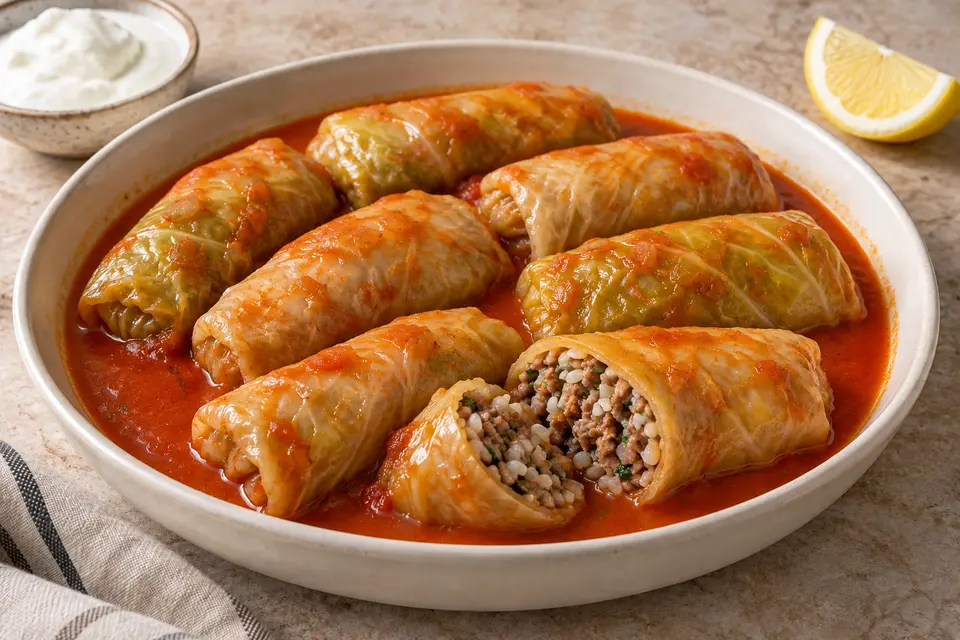
Sarma takes its name from the Turkish verb sarmak, meaning to wrap or roll. Across Türkiye, cooks wrap grape leaves, cabbage and other greens around fillings that change with region and season. Etli Lahana Sarması is especially associated with cold-weather tables, but there is no single national filling: official regional records from Malatya and Isparta, for example, document meat-and-bulgur versions. This recipe presents a practical white-cabbage version with beef and rice. It is distinct from the earthier black-cabbage rolls of the Black Sea region.
Etli Lahana Sarması — Recipe Card
Turkish cabbage rolls with beef, rice, herbs and tomato-pepper sauce
Makes 6 servingsUS cup = 240 ml · tablespoon = 15 ml · teaspoon = 5 ml. Cup and weight conversions are approximate. Australian cooks: use a 15 ml measuring tablespoon.
Ingredient quantities and servings are scaled. Cooking times, pan sizes, frying oil depth, and temperatures stay the same; cook larger batches as needed.
Ingredients
How to make Etli Lahana Sarması
Soften the cabbage leaves
Bring a large pot of water to a steady boil. Lower in the cored cabbage. As the outer leaves become flexible, after about 2–3 minutes, lift them away with tongs and transfer them to a tray to cool. Return the head to the water and repeat until you have 24–30 usable leaves.
Trim and size the leaves
Shave down the thick central rib on each leaf without cutting through it. Cut very large leaves into two pieces. Keep the small leaves and thick trimmings; spread them across the bottom of a wide, heavy pot to protect the rolls from direct heat.
Mix the filling
Put the ground beef, drained rice, grated onion, 30 g (2 tbsp) tomato paste, red pepper paste, 45 ml (3 tbsp) olive oil, parsley, mint, 8 g (1⅓ tsp) salt, black pepper and pul biber in a bowl. Mix gently with clean hands just until evenly combined; do not compact the filling.
Shape the rolls
Place a cabbage piece smooth-side down with the stem edge nearest you. Add about 1½ tbsp filling in a short line near that edge. Fold the sides inward and roll away from you, keeping the parcel secure but leaving slight room for the rice to expand. Repeat with the remaining leaves and filling.
Pack the pot
Arrange the rolls seam-side down in snug concentric layers over the cabbage trimmings. Keep them close enough to support one another, but do not crush them. Place a small heatproof plate upside down over the top layer to stop the rolls from opening.
Simmer gently
Whisk the remaining 15 g (1 tbsp) tomato paste, 15 ml (1 tbsp) olive oil and 4 g (⅔ tsp) salt into the hot water. Pour in enough to reach about two-thirds of the way up the rolls. Bring just to a simmer over medium heat, then cover, reduce the heat to low and cook for 45–55 minutes. Add a little more hot water if the pot becomes dry. The cabbage and rice should be tender and the center of a roll must reach 71°C/160°F.
Rest and serve
Remove the plate carefully, cover the pot again and rest off the heat for 10 minutes. Serve the rolls hot with spoonfuls of their cooking liquid and lemon wedges. Plain yogurt may be offered alongside if desired.
Bring this recipe to your kitchen with a printable copy.
Print recipeRecipe from MyTurkishRecipes · https://myturkishrecipes.com/turkish-stuffed-cabbage-rolls-etli-lahana-sarmasi. Quantities reflect your selected serving scale. Cooking times are estimates; follow the doneness cues.
Make it work in your kitchen
Ingredient Substitutions
These swaps change flavor or texture as described. Keep the original ingredients for the closest version of the dish.
Pul biber
Use the same amount of mild paprika for color and a gentler flavor. For heat, add a small pinch of chili flakes, then taste; chili flakes can be much hotter.
Turkish red pepper paste
Use the same quantity of tomato paste, then add mild paprika to taste. This gives a more tomato-forward flavor and will not reproduce the full pepper flavor.
A few helpful kitchen notes
Regional context
This is a white-cabbage, beef-and-rice version. Turkish regional recipes also include meat-and-bulgur fillings, while Black Sea kara lahana sarması uses dark leafy black cabbage; they are related traditions, not interchangeable names for the same dish.
Meat variation
Use 450 g/1 lb ground lamb or a beef-and-lamb blend in place of the beef. Keep the other quantities and cook the center of a roll to 71°C/160°F.
Heat level
Mild. Use mild tatlı biber salçası and the listed mild pul biber. For no added chili, omit the pul biber; for a hotter pot, replace up to half the mild pepper paste with hot acılı biber salçası or add more pul biber.
Dietary note
No wheat is intentionally added, but pepper paste, tomato paste and ground spices can vary by brand and handling. Check every packaged product and cross-contact information if avoiding gluten; this recipe does not claim gluten-free certification.
How to store and reheat Etli Lahana Sarması
Refrigerate cooked rolls within 2 hours in a shallow covered container at 4°C/40°F or below and use within 3 days. Reheat covered with a splash of water until the center reaches 74°C/165°F; reheat only the portion you plan to serve.
Etli Lahana Sarması: questions and answers
Can I use Savoy cabbage?
Yes. Savoy leaves are usually more pliable, so begin checking them after 1–2 minutes in the boiling water and remove each leaf as soon as it bends without cracking.
Why did my cabbage rolls split?
The leaves may have been overcooked, the thick rib may not have been trimmed, or the rolls may have been packed too tightly. Blanch only until flexible and leave a little expansion room around the raw rice.
Can I replace the beef with lamb?
Yes. Use the same weight of ground lamb or a beef-and-lamb blend and cook the filling to the same safe center temperature of 71°C/160°F.
Can I make Etli Lahana Sarması ahead?
Yes. Cook the rolls, cool and refrigerate them promptly, then reheat as directed in the storage guidance. Add a small splash of water so the cabbage stays supple while reheating.