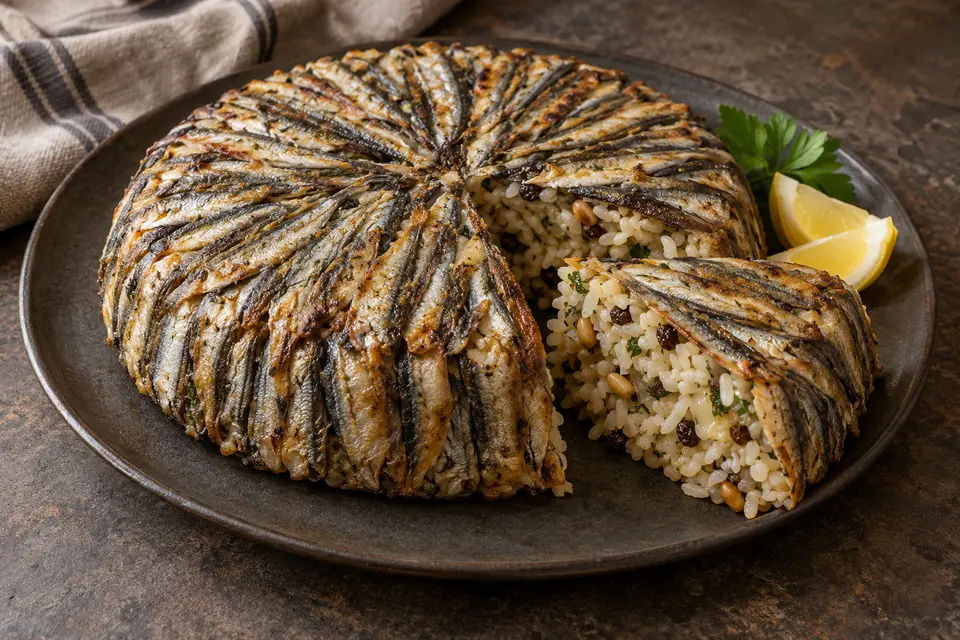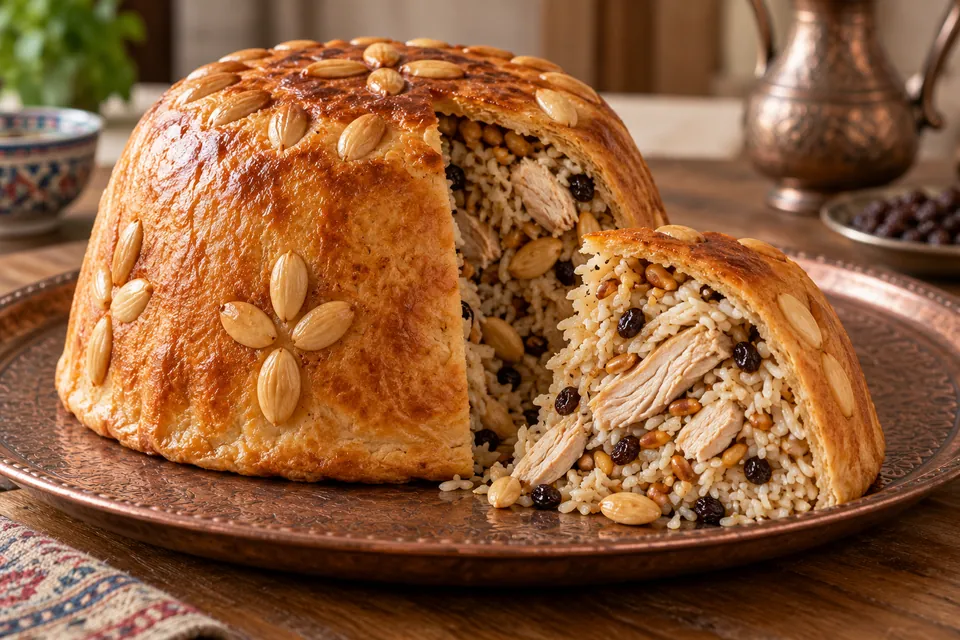
Siirt Perde Pilavı has been registered in Türkiye as a geographical indication since 15 July 2004. Official cultural sources connect it closely with weddings and important guests in Siirt: the pastry ‘curtain’ represents the home and its privacy, rice represents abundance, and the nuts, currants and spices carry wishes for family life. The registered method allows chicken or partridge, layers the meat with butter-toasted rice and bakes everything inside very thin dough in a tall, fez-like mould. This measured home version follows the chicken variation and uses a deep Bundt mould or ovenproof bowl when the traditional copper pot is unavailable.
Siirt Perde Pilavı — Recipe Card
Siirt-style chicken rice baked inside a golden almond-patterned pastry shell
Makes 8 servings · Makes one 2-litre (8-cup) pastry-wrapped pilafUS cup = 240 ml · tablespoon = 15 ml · teaspoon = 5 ml. Cup and weight conversions are approximate. Australian cooks: use a 15 ml measuring tablespoon.
Ingredient quantities and servings are scaled. Cooking times, pan sizes, frying oil depth, and temperatures stay the same; cook larger batches as needed.
Ingredients
How to make Siirt Perde Pilavı
Poach the chicken and make the stock
Put the 1.2 kg (2.6 lb) chicken pieces in a large saucepan with the 1.5 litres (6 1/4 cups) cold water and 3 g (1/2 tsp) of the salt. Bring slowly to a simmer, skim the surface and cook gently for 25–35 minutes, until the thickest pieces reach 74°C (165°F). Transfer the chicken to a plate. Strain the stock and reserve 600 ml (2 1/2 cups) while hot.
Soak the rice and currants
Cover the 400 g (2 cups) rice with warm water, add 3 g (1/2 tsp) of the salt and leave for 20 minutes. Rinse repeatedly until the water is almost clear, then drain well. In a separate small bowl, cover the 25 g (3 tbsp) currants with warm water for 10 minutes and drain.
Make and rest the dough
Whisk the 3 eggs with the 15 g (1 tbsp) yogurt, 15 ml (1 tbsp) oil, 2 g (1/2 tsp) baking soda and 1 g (a scant 1/4 tsp) of the remaining salt. Add the 300 g (2 1/2 cups) flour gradually and knead for 5 minutes, until smooth, soft and no longer sticky. Cover and rest for 20 minutes.
Prepare the chicken
When the chicken is cool enough to handle, remove and discard the skin and bones. Keep the meat in generous bite-size pieces rather than finely shredding it. Confirm that no bone fragments remain.
Part-cook the spiced pilaf
Melt the 60 g (4 tbsp) butter in a wide saucepan over medium heat. Add the 50 g (1/3 cup) pine nuts and 50 g (1/3 cup) pilaf almonds; cook for 2–3 minutes until lightly golden. Add the drained rice and stir for 3 minutes. Stir in the currants, 2 g (1 tsp) black pepper, 1 g (1/2 tsp) cumin, 1 g (1/2 tsp) sweet paprika, 0.5 g (1/4 tsp) cinnamon and the final 2 g (1/3 tsp) salt. Pour in the 600 ml (2 1/2 cups) hot stock, cover and simmer on low for 9–11 minutes, until the stock is absorbed but the rice is still firm. Remove from the heat and rest, covered, for 10 minutes.
Prepare the mould
Heat the oven to 180°C (350°F). Coat every surface of a 2-litre (8-cup) deep Bundt mould, pudding mould or ovenproof bowl with most of the 30 g (2 tbsp) softened butter, reserving about 1 teaspoon. Press the 50 g (1/3 cup) whole blanched almonds into simple patterns around the base and sides.
Roll and line the pastry shell
Set aside one quarter of the dough for the lid. On a lightly floured surface, roll the larger piece to about 2 mm (1/16 inch) thick and wide enough to line the mould with 5–7 cm (2–3 inches) overhanging the rim. Ease it into the mould without disturbing the almonds and press out air pockets. Patch any tear with a small piece of dough.
Layer the filling
Spoon one third of the pilaf into the pastry-lined mould and press very gently. Add half the chicken in an even layer. Repeat with another third of pilaf, the remaining chicken and the final pilaf. Keep the filling below the rim and press only enough to remove large gaps.
Seal and bake
Roll the reserved dough into a round lid. Fold the overhanging pastry over the rice, place the lid on top and pinch the seams firmly to seal. Spread the reserved teaspoon of butter over the closed surface. Bake for 40–45 minutes, until the pastry is deep golden and the centre of the filling reaches 74°C (165°F).
Rest, turn out and serve
Rest the pilaf in its mould for 15 minutes. Run a thin knife only around the rim, place a large serving plate over the mould and invert decisively. Lift off the mould, cut the dome into wedges with a serrated knife and serve hot.
Bring this recipe to your kitchen with a printable copy.
Print recipeRecipe from MyTurkishRecipes · https://myturkishrecipes.com/turkish-pastry-wrapped-chicken-rice-siirt-perde-pilavi. Quantities reflect your selected serving scale. Cooking times are estimates; follow the doneness cues.
A few helpful kitchen notes
Traditional shape
The registered Siirt method uses a tall copper pot shaped like a fez. A deep Bundt mould or rounded ovenproof bowl gives a practical home approximation; a shallow pie dish will not produce the characteristic dome.
Documented variations
The geographical-indication formula uses chicken or partridge, pine nuts, almonds, currants and spices. Another official Siirt recipe includes chicken liver. This version follows the registered chicken formula without liver.
Heat level
Mild. Sweet paprika gives colour without notable heat. For a hotter version, replace the sweet paprika with 1/2 tsp Turkish pul biber; the flavour will be sharper than the base recipe.
Dietary notes
This recipe contains wheat, eggs, milk, almonds and pine nuts. It is not vegetarian, vegan or gluten-free, and the egg-rich pastry has not been tested with a one-for-one gluten-free flour substitute.
How to store and reheat Siirt Perde Pilavı
Divide leftovers into shallow containers and refrigerate within 2 hours at 4°C (40°F) or below. Keep for 3–4 days. Reheat only the portions needed, covered, until both the rice and chicken reach 74°C (165°F). For best quality, freeze tightly wrapped portions for up to 1 month and thaw in the refrigerator; the pastry will soften after freezing.
Siirt Perde Pilavı: questions and answers
Can I make Perde Pilavı without the special copper pot?
Yes. Use a well-buttered 2-litre (8-cup) deep Bundt mould, pudding mould or rounded ovenproof bowl. Check that it is oven-safe and leave enough pastry overhang to seal the base.
Why did the pastry stick to the mould?
The mould may not have been buttered completely, or the pilaf may have been turned out too soon. Coat every groove, rest for 15 minutes after baking and loosen only the top rim before inverting.
Why is the rice soft instead of separate?
The rice was probably fully cooked before assembly or not drained well after soaking. Stop the stovetop cooking while the grains are still firm because they continue steaming inside the sealed pastry.