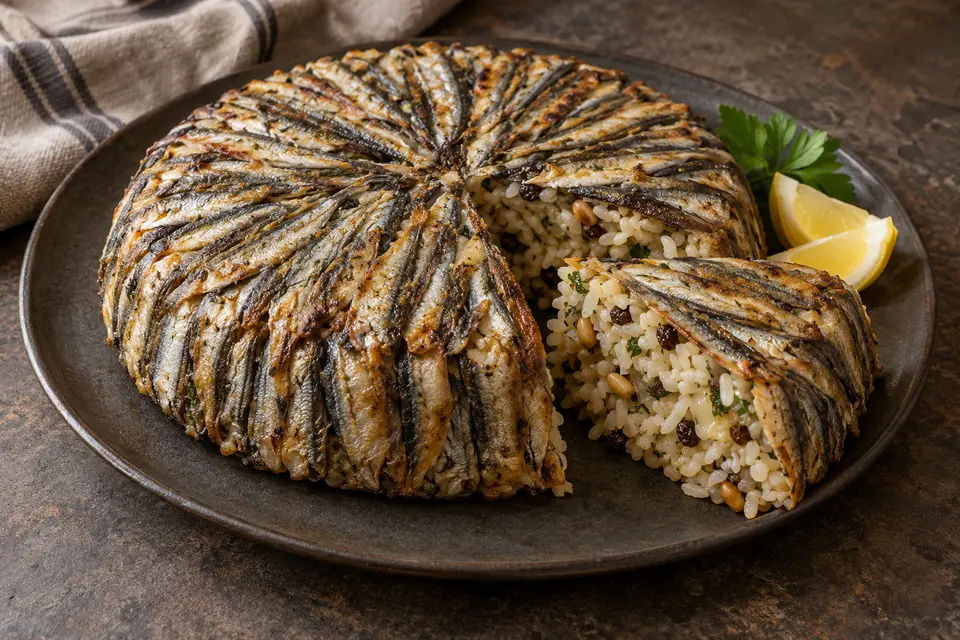
Anchovy has a central place in the cooking of Türkiye's Black Sea coast, especially around Trabzon and Rize. Official regional recipes agree on the defining technique: cleaned anchovies line a baking dish, rice fills the center, and more fish close the top before baking. The details vary. A simpler Rize version may use onion, oil and black pepper, while the Trabzon version enriches the rice with pine nuts, currants, mint, cinnamon and parsley. This recipe follows that aromatic Trabzon-style pattern in a 23 cm round pan, while keeping the fish-and-rice structure shared across the region.
Hamsili Pilav — Recipe Card
Black Sea anchovy rice baked in a crisp fish shell
Makes 6 servings · One 23 cm / 9-inch round, serving 6US cup = 240 ml · tablespoon = 15 ml · teaspoon = 5 ml. Cup and weight conversions are approximate. Australian cooks: use a 15 ml measuring tablespoon.
Ingredient quantities and servings are scaled. Cooking times, pan sizes, frying oil depth, and temperatures stay the same; cook larger batches as needed.
Ingredients
How to make Hamsili Pilav
Rinse and soak the rice
Rinse the rice in several changes of cool water until the water is nearly clear. Cover with warm water and leave for 20 minutes, then drain very well.
Prepare the anchovies
Keep the cleaned anchovies cold while you work. Check for any remaining backbones, rinse only if necessary, then pat every fillet thoroughly dry. Season the fish with 2 g (about 1/3 teaspoon) of the salt and return it to the refrigerator. Wash the board, knife and your hands before handling the cooked filling.
Build the aromatic base
Heat 45 ml (3 tablespoons) of the olive oil in a saucepan over medium heat. Add the pine nuts and stir for 2 minutes, until pale gold. Add the onion and cook for 6–8 minutes until soft but not browned. Stir in the currants, black pepper, cinnamon, mint and the remaining salt for 30 seconds.
Part-cook the pilaf
Add the drained rice and stir gently for 2 minutes so the grains are coated. Pour in the 450 ml hot water and bring to a boil. Cover, reduce the heat to low and cook for 10 minutes, until the liquid is almost absorbed but the rice is still slightly firm. Remove from the heat, rest covered for 10 minutes, then fold in the parsley without crushing the grains.
Line the pan
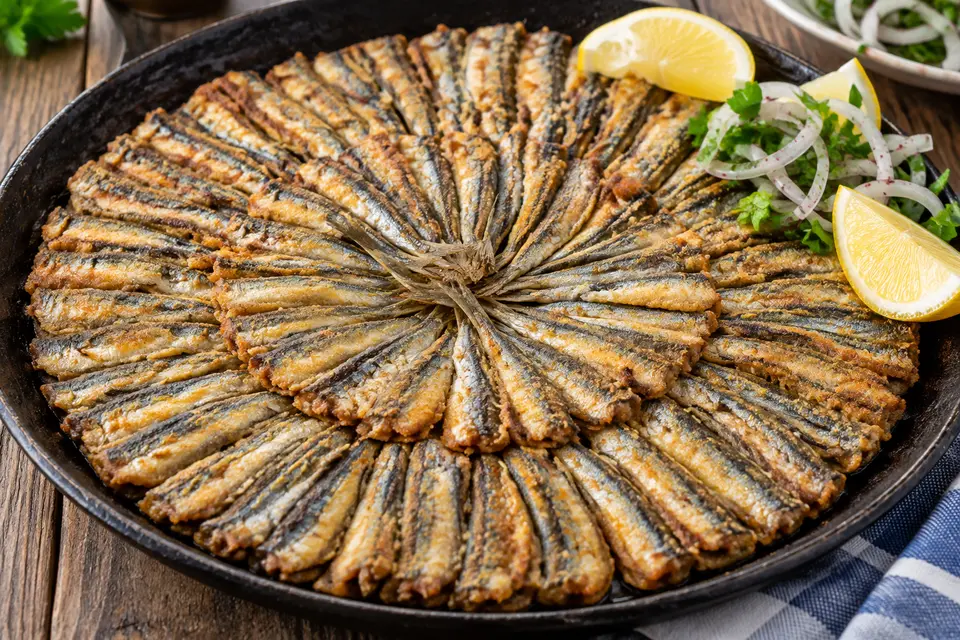
Heat the oven to 190°C / 375°F. Brush a 23 cm / 9-inch round cake pan or ovenproof skillet with the remaining 15 ml (1 tablespoon) olive oil and dust it with the cornmeal. Arrange about two-thirds of the anchovies skin-side against the base and sides in a tight radial pattern, overlapping each fillet by about one-third and letting the side fillets extend just above the rim.
Fill and seal
Spoon the warm pilaf into the fish-lined pan and level it lightly; do not compress it. Fold the overhanging fish over the rice, then cover every remaining gap with the reserved anchovies, keeping the flesh against the rice. The filling should be fully enclosed.
Bake, check and turn out
Bake for 30–35 minutes, until the anchovies are browned, opaque and flake easily, and the thickest fish layer reaches 63°C / 145°F. Rest for 10 minutes. Run a thin spatula around the edge, place a platter over the pan and invert carefully. Serve hot with lemon wedges.
Bring this recipe to your kitchen with a printable copy.
Print recipeRecipe from MyTurkishRecipes · https://myturkishrecipes.com/black-sea-anchovy-rice-hamsili-pilav. Quantities reflect your selected serving scale. Cooking times are estimates; follow the doneness cues.
A few helpful kitchen notes
Regional style
The pine nuts, currants, mint, cinnamon and parsley follow the aromatic Trabzon-style preparation. For a plainer Rize-style filling, omit the pine nuts, currants and cinnamon and keep the onion, parsley and black pepper.
Fish choice
Use small, uncured European anchovies, fresh or thawed in the refrigerator. Salt-cured anchovies sold in jars are too salty and too small for lining the pan.
Allergens and dietary
Contains fish and pine nuts. The base recipe contains no dairy. If gluten avoidance is required, use cornmeal specifically labelled gluten-free and check all packaged spices; this does not guarantee absence of cross-contact or suitability for coeliac disease.
Heat level
No added chili. Black pepper gives only gentle warmth; offer pul biber at the table for diners who want more heat rather than changing the base filling.
How to store and reheat Hamsili Pilav
Refrigerate leftovers in shallow covered containers within 2 hours and keep at 4°C / 40°F or below for up to 3–4 days. Reheat only the portion needed, covered, until the center reaches 74°C / 165°F. Do not leave the fish-and-rice dish at room temperature for more than 2 hours.
Hamsili Pilav: questions and answers
Can I make Hamsili Pilav with frozen anchovies?
Yes. Thaw them completely in the refrigerator, clean and butterfly them if needed, and pat them very dry before lining the pan. Do not thaw seafood on the counter.
Can I omit the pine nuts and currants?
Yes. Black Sea versions vary, and a simpler Rize-style filling can rely on onion, parsley and black pepper. The fish-lined baking method is the essential feature.
Do I have to invert the pilaf?
No; it can be served from the baking dish. Inverting it displays the crisp radial anchovy pattern, so a well-oiled, cornmeal-dusted pan is worth using when presentation matters.