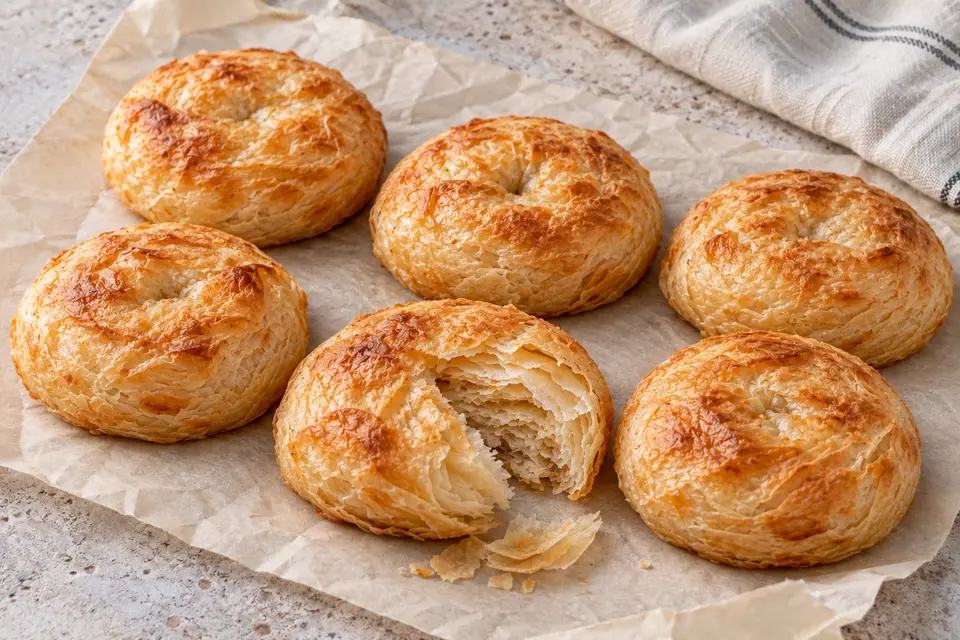
Turkish Patent and Trademark Office registration no. 268 describes İzmir Boyozu as a pastry made in İzmir since the Ottoman period and records its long home-baking history. Official İzmir sources connect it with the city’s Sephardic heritage and breakfast table, commonly alongside a hard-boiled egg and tea. The protected product is made in İzmir; this recipe is a respectful home interpretation of its registered plain form, not a claim of geographical-indication certification.
İzmir Boyozu — Recipe Card
İzmir’s Unleavened Flaky Breakfast Pastry
Makes 12 servingsUS cup = 240 ml · tablespoon = 15 ml · teaspoon = 5 ml. Cup and weight conversions are approximate. Australian cooks: use a 15 ml measuring tablespoon.
Ingredient quantities and servings are scaled. Cooking times, pan sizes, frying oil depth, and temperatures stay the same; cook larger batches as needed.
Ingredients
How to make İzmir Boyozu
Knead the dough
Combine the flour and salt in a large bowl. Add the 360 ml (1 1/2 cups) water and mix until no dry flour remains. Knead on an unfloured surface for 10–12 minutes, until smooth, firm and elastic. Do not taste the raw dough.
Give it the first rest
Cover the dough with a clean, lightly damp cloth and rest at 68–77°F (20–25°C) for 15 minutes. Divide into 4 equal pieces of about 250 g (8.8 oz) and shape each into a tight ball.
Layer the pairs
Stir the softened pastry margarine and tahini into a smooth, plastic paste. Press each ball into an even 6 in (15 cm) disk. Spread half the tahini-fat mixture over one disk, stopping 1/2 in (1 cm) from the edge, and cover with a second disk. Press the edges firmly together. Repeat with the remaining pair.
Oil and rest again
Lightly coat the top and bottom of both paired disks with 1 tbsp of the sunflower oil. Cover with the damp cloth and rest at room temperature for 15 minutes. The dough should relax enough to roll without springing back.
Stretch and fold
Working with one paired disk at a time, roll it evenly from center to edge, then lift and stretch it by hand into a very thin circle about 28–30 in (70–75 cm) wide; keep the edge and center close to the same thickness. Sprinkle with a little of the remaining oil. Fold the lower half over the upper half, fold the right and left sides toward the center, then fold the far edge toward the center twice. Roll the folded sheet from top to bottom into a long, even cylinder. Repeat with the second disk.
Portion and shape
Cover the cylinders and rest for 15 minutes. Tear or cut each cylinder into 6 equal pieces. For each piece, tuck the exposed cut layers inward toward the center to make a small navel, place seam-side down on an oiled parchment-lined tray and press gently into a 3–3 1/2 in (7–9 cm) round about 1–1 1/4 in (2.5–3.5 cm) thick. Brush with the last of the oil, cover and rest for 15 minutes.
Bake until lightly caramelized
While the shaped pastries rest, heat the oven to 375°F (190°C). Bake for 18–22 minutes, rotating the tray after 12 minutes, until the tops are evenly light caramel in color, with no raw pale patches or burnt edges. Cool on the tray for 15 minutes before serving.
Bring this recipe to your kitchen with a printable copy.
Print recipeRecipe from MyTurkishRecipes · https://myturkishrecipes.com/turkish-flaky-breakfast-pastry-izmir-boyozu. Quantities reflect your selected serving scale. Cooking times are estimates; follow the doneness cues.
A few helpful kitchen notes
Registered ratios
The water is 57.6% and the salt 3.8% of the flour weight, within the registered 55–60% water and 3.5–4% salt ranges. The 90 g tahini-fat blend is about 8.9% of the dough weight, and tahini forms 16.7% of that blend.
Pastry fat
Use a firm block made for baking, not a soft tub spread. All-vegetable shortening is the closest widely available alternative. The same weight of unsalted butter works, but its water content and lower melting point make the dough harder to stretch and the result less characteristic.
Dietary and allergen notes
The recipe is vegan and vegetarian only when the pastry fat is clearly labelled dairy-free. It contains wheat/gluten and sesame from tahini; it is not suitable for a gluten-free adaptation with a simple one-for-one flour swap.
Heat level
No added chili. Plain İzmir Boyozu is savory but not spicy. Filled modern variations exist, but this recipe preserves the registered plain style.
Raw flour safety
Flour is a raw ingredient: do not taste the dough, and wash hands, bowls, tools and work surfaces with warm soapy water after handling it. Baking is the kill step.
How to store and reheat İzmir Boyozu
Boyoz is best the day it is baked. Once fully cool, keep it covered at room temperature for up to 24 hours, consistent with the registered guidance for the unfilled pastry. Recrisp for 5–7 minutes at 350°F (175°C). For longer storage, freeze airtight for up to 1 month and reheat from frozen for 10–12 minutes; discard any pastry showing mold or an off odor.
İzmir Boyozu: questions and answers
Does İzmir Boyozu contain yeast?
No. The registered plain dough is made from wheat flour, water and salt. Resting relaxes the gluten for stretching; it does not ferment or make the pastry rise like bread.
Why is tahini mixed into the pastry fat?
The registered method requires tahini at no less than 15% of the pastry-fat mixture. This small amount contributes flavor and helps define the traditional layering without turning boyoz into a sweet tahini bun.
How is boyoz served in İzmir?
It is commonly eaten warm at breakfast with a hard-boiled egg and Turkish tea. Those are serving companions, not ingredients in the plain pastry.
Why did my dough tear while stretching?
It was probably too cold, insufficiently kneaded or not rested long enough. Cover it and wait 10 minutes, keep your hands lightly oiled, and stretch from several points rather than pulling one edge hard.