Poğaça comes in many shapes and fillings, including cheese, olives and potato. Both yeast-raised and baking-powder versions are made in Turkish home and bakery cooking. This recipe is the yeast-raised kind, with yogurt, milk and oil in the dough and a separate cheese filling; it is not a laminated börek or puff pastry.
Peynirli Poğaça — Recipe Card
Soft Turkish yeast-raised pastries with white cheese and parsley
Makes 12 servings · Makes 12 medium filled pastries; one serving is one pastry. Rising times vary with room temperature.US cup = 240 ml · tablespoon = 15 ml · teaspoon = 5 ml. Cup and weight conversions are approximate. Australian cooks: use a 15 ml measuring tablespoon.
Ingredient quantities and servings are scaled. Cooking times, pan sizes, frying oil depth, and temperatures stay the same; cook larger batches as needed.
Ingredients
How to make Peynirli Poğaça
Mix the dough
Stir the flour, instant yeast, sugar and salt in a large bowl. Warm the milk to about 35–38°C (95–100°F); it should be lukewarm, not hot. Mix in the yogurt, oil and one beaten egg, then combine with the dry ingredients until no loose flour remains.
Knead and let rise
Knead by hand for 8–10 minutes until smooth and soft, with a slight tack rather than a wet coating on your fingers. If unusually dry, work in water a teaspoon at a time, up to 15 ml (1 tbsp); if very sticky, work in up to 15 g (2 tbsp) extra flour. Cover in the bowl and leave in a comfortably warm spot for about 60 minutes, until nearly doubled; allow 45–75 minutes depending on the room.
Prepare the filling
Crumble the drained cheese and mix it with the parsley. Keep refrigerated while the dough finishes rising. Line two baking trays with parchment. Beat the remaining egg in a small bowl for the glaze.
Divide and fill
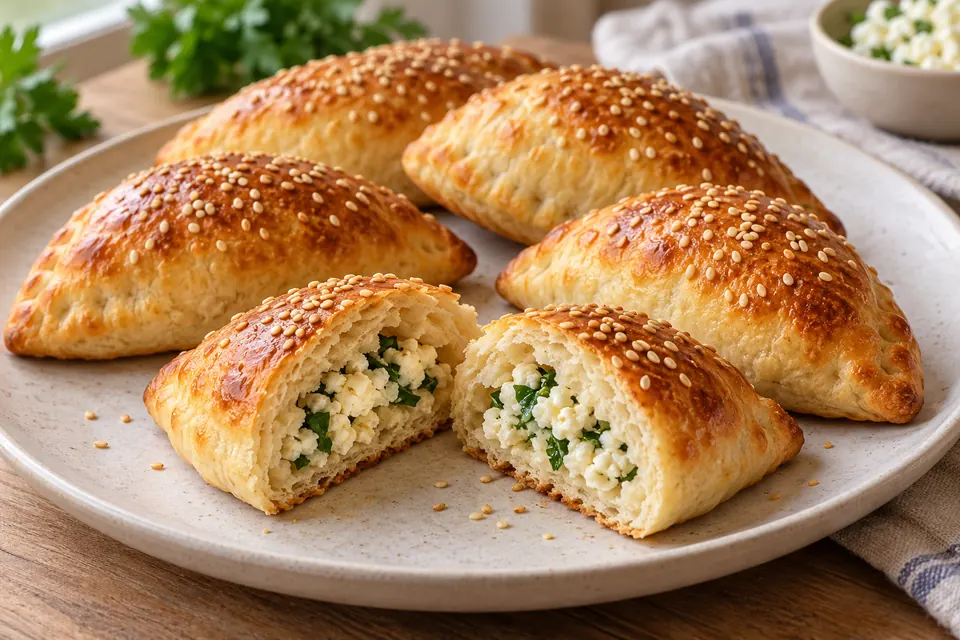
Gently press the air out of the dough and divide into 12 equal pieces. Flatten each into a circle about 10 cm (4 in) wide. Divide all the filling evenly between them, placing it on one half and leaving a clean border. Fold the empty half over and pinch the curved edge firmly closed to make a half-moon.
Proof and heat the oven
Place the pastries on the trays with about 4 cm (1½ in) between them. Cover loosely and leave for about 20 minutes, until slightly puffy. Meanwhile, heat a conventional oven to 180°C (350°F). Brush the tops gently with the beaten egg and sprinkle evenly with the sesame seeds. Discard unused raw egg glaze.
Bake until golden
Bake for 25–30 minutes, until golden on top with lightly browned, firm bases and fully set dough at the seams. If baking both trays together, swap their positions and rotate them halfway through. If a top darkens too quickly, tent loosely with foil. A pastry opened at the seam should have a baked crumb, not sticky raw dough.
Cool briefly and serve
Transfer to a rack and rest for 10 minutes so the crumb settles and the filling is not piping hot. Serve warm. Refrigerate any pastries you are keeping within the storage time limits below.
Bring this recipe to your kitchen with a printable copy.
Print recipeRecipe from MyTurkishRecipes · https://myturkishrecipes.com/turkish-cheese-pastries-peynirli-pogaca. Quantities reflect your selected serving scale. Cooking times are estimates; follow the doneness cues.
Make it work in your kitchen
Ingredient Substitutions
These swaps change flavor or texture as described. Keep the original ingredients for the closest version of the dish.
Turkish white cheese
Use the same weight of firm feta, well drained. Taste before adding salt: feta varies in saltiness. The filling may be tangier and slightly drier.
A few helpful kitchen notes
Dough consistency
Flour and yogurt vary. The small water or flour adjustments in the kneading step are for texture, not a change to the base recipe. Weigh the flour and use ordinary plain yogurt; very thick Greek-style yogurt makes the dough drier.
Yeast
Use instant yeast as listed. Baking powder is not a direct substitute in this dough; a quick, unleavened-style poğaça needs a different formula. Judge the rise by the dough's volume as well as the clock.
Cheese and dietary notes
Choose cheese made with vegetarian rennet to keep this recipe vegetarian. Drain brined cheese well and do not add salt to the filling. Contains wheat, milk, eggs and sesame; it is not gluten-free. Sesame may be omitted without changing the dough or baking method.
Heat level
No added chili. The cheese-and-parsley filling is mild; serve chili flakes separately if someone prefers a hotter accompaniment.
How to store and reheat Peynirli Poğaça
Refrigerate in a covered container at 4°C (40°F) or colder within 2 hours of baking, or within 1 hour if the surroundings are above 32°C (90°F). Eat within 3 days, or freeze individually wrapped for up to 2 months for best quality. Thaw overnight in the refrigerator. Reheat at 160°C (325°F), loosely covered, until the center reaches 74°C (165°F); check with a food thermometer. Discard pastries left out beyond the stated limits.
Peynirli Poğaça: questions and answers
Can I make round poğaça instead of half-moons?
Yes. Put the same share of filling in the center of each dough round, gather the edges and pinch closed. Set seam-side down, then use the same proofing and baking instructions; check that the thicker center is fully baked.
Why did the cheese leak out?
Wet cheese, filling caught in the seam or a loosely closed edge can let the pastries open. Drain the cheese, leave the border clean and pinch firmly. Use the stated amount of filling and avoid overproofing after shaping.
Can I prepare the dough overnight?
After kneading, cover and refrigerate promptly for 8–12 hours instead of the room-temperature first rise. If it has not nearly doubled, let it finish rising after removal from the refrigerator. Fill and shape as directed; the second rise may take longer while the dough warms.
Do I need to activate instant yeast in milk first?
Not for the instant yeast specified here; it can be mixed into the flour. Follow your yeast packet if using a different type, and do not mix the yeast with hot milk.