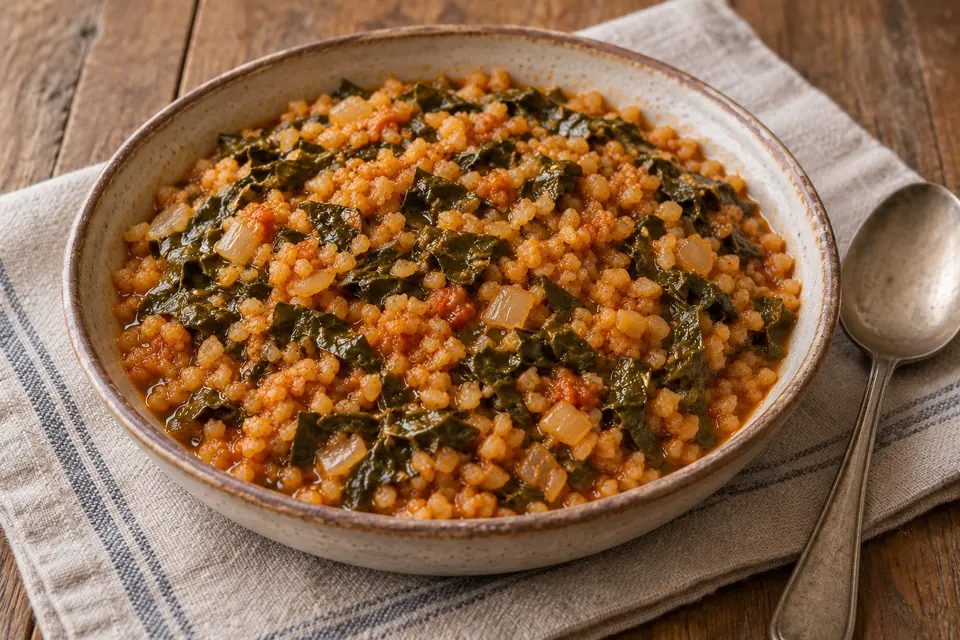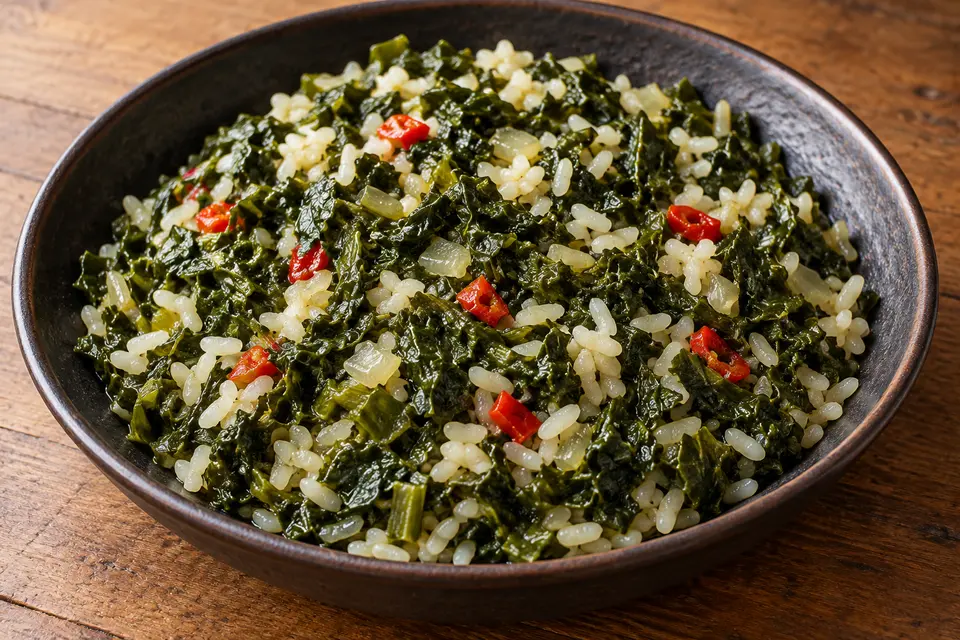
Türkiye’s Culture Portal records the Giresun method with collard greens—locally also called pancar—rice, four onions, butter and one hot pepper. Its defining technique is layering: half the sliced greens go into the pot first, the rice and onions sit in the middle, and the remaining greens cover them while the closed pot cooks. An official Ordu version of pancar diblesi instead briefly boils the greens and rice before draining and frying them with onion. This recipe follows Giresun’s layered approach, adding a measured amount of hot water and clear heat cues so the rice cooks reliably in a home kitchen.
Karalahana Diblesi — Recipe Card
Giresun-Style Collard Greens and Rice
Makes 8 servings · 8 side-dish servingsUS cup = 240 ml · tablespoon = 15 ml · teaspoon = 5 ml. Cup and weight conversions are approximate. Australian cooks: use a 15 ml measuring tablespoon.
Ingredient quantities and servings are scaled. Cooking times, pan sizes, frying oil depth, and temperatures stay the same; cook larger batches as needed.
Ingredients
How to make Karalahana Diblesi
Prepare the greens and rice
Wash the collard greens thoroughly under running water and dry them. Cut out the tough central ribs, stack the leaves and slice them crosswise into ribbons about 5 mm/¼ inch wide. Rinse the rice in several changes of cool water until the water is mostly clear, then drain it well.
Build the Giresun-style layers
Spread half the sliced greens in a wide, heavy 5–6 litre pot. Scatter the drained rice evenly over them, then add the chopped onions. Cover with the remaining greens and sprinkle over the salt. Pour the 400 ml/1⅔ cups hot water down the side so the layers remain in place.
Steam without stirring
Cover the pot and bring it to a lively simmer over medium heat, about 5 minutes. Reduce the heat to low and cook, still covered and without stirring, for 20 minutes. The greens should collapse and the rice should absorb the liquid released by the vegetables.
Check the rice and make the pepper butter
Lift the lid and taste a grain from the centre. If it is still firm and the base looks dry, add 60 ml/¼ cup more hot water, cover and cook for 5–8 minutes. Meanwhile, melt the butter in a small pan, add the sliced hot pepper and sizzle for 30–45 seconds without browning the butter.
Finish, rest and serve
Pour the hot pepper butter over the greens and rice. Fold the layers together gently, cover and cook on low for 3 minutes. Remove from the heat and rest, covered, for 10 minutes. Fluff once more so the rice and greens are evenly distributed, then serve hot.
Bring this recipe to your kitchen with a printable copy.
Print recipeRecipe from MyTurkishRecipes · https://myturkishrecipes.com/turkish-collard-greens-and-rice-karalahana-diblesi. Quantities reflect your selected serving scale. Cooking times are estimates; follow the doneness cues.
A few helpful kitchen notes
Regional method
The documented Giresun version layers raw sliced collard greens around rice and onion, then adds peppered butter near the end. Ordu’s documented pancar diblesi briefly boils and drains the greens and rice before frying them with onion; that is a related regional variation, not the method used here.
Water adjustment
Collard greens vary in age and moisture, so the measured water is intentionally modest. Add the extra 60 ml/¼ cup only after the first covered cooking period if the rice is still firm and the bottom of the pot is dry.
Heat level
Medium with one small hot red pepper. For a mild pot, remove the seeds and membrane or use a mild red pepper. For a hotter version, add a second hot pepper to the butter; do not change the base recipe’s salt or water.
Dietary notes
Vegetarian and naturally gluten-free as written. Use butter and spices whose labels meet your needs and check cross-contact information when required; this is not a certification of suitability for coeliac disease. For a vegan variation, replace the 30 g butter with 30 ml/2 tbsp olive oil.
Rice safety
Do not leave the cooked dible at room temperature for longer than 2 hours. Cool leftovers promptly in shallow containers because cooked rice and other prepared foods can support Bacillus cereus when held warm for too long.
How to store and reheat Karalahana Diblesi
Transfer leftovers to shallow covered containers and refrigerate within 2 hours at 4°C/40°F or below. Eat within 4 days. Reheat only the portion you need to 74°C/165°F, adding a spoonful of water if the rice seems dry; discard food left at room temperature for more than 2 hours.
Karalahana Diblesi: questions and answers
Is karalahana the same as kale?
Karalahana is the dark leafy brassica commonly translated as collard greens or black cabbage. Broad, sturdy collard leaves are the closest widely available choice; very curly kale cooks differently and gives a rougher texture.
Why is the dish called dible?
In Black Sea cooking, dible refers to a family of dishes that combine a vegetable with rice and onion. The vegetable may change by season and locality; this Giresun version centres on karalahana.
Can I cook the rice separately?
Cooking it separately would miss the defining layered technique and the way the rice absorbs liquid from the greens and onions. If your rice remains firm, add a small measured amount of hot water rather than boiling it in another pan.