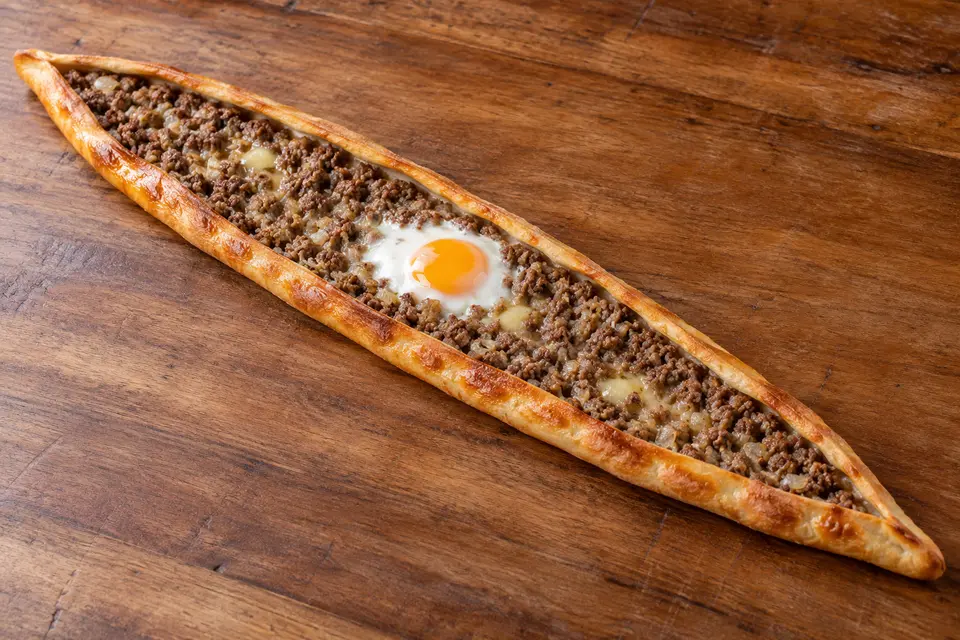
TÜRKPATENT registered Ordu Pidesi / Ordu Yağlısı as geographical indication number 1324 in 2023. The registration describes a semi-open pide with two separate rises, a 200 g dough portion and a 100–150 g filling, traditionally stretched to roughly 70–80 cm before baking in a hot wood-fired stone oven. The pide has an established place in Ordu's food culture, particularly at Sunday breakfast. One local practice is to prepare the filling at home and take it to a neighborhood bakery, where the baker shapes and bakes the pide. It is commonly served whole, without slicing, and eaten by hand.
Ordu Pidesi / Ordu Yağlısı — Recipe Card
Long Black Sea Pide with Beef, Onion and Butter
Makes 4 servings · Makes 4 long home-oven pides, each a generous individual serving.US cup = 240 ml · tablespoon = 15 ml · teaspoon = 5 ml. Cup and weight conversions are approximate. Australian cooks: use a 15 ml measuring tablespoon.
Ingredient quantities and servings are scaled. Cooking times, pan sizes, frying oil depth, and temperatures stay the same; cook larger batches as needed.
Ingredients
How to make Ordu Pidesi / Ordu Yağlısı
Mix the soft dough
Crumble the fresh yeast into the lukewarm water and stir in the optional sugar. Add the flour and 8 g/1⅓ tsp of the salt. Mix until no dry flour remains, then knead for 8–10 minutes until the dough is soft, smooth and slightly tacky. Do not taste the raw dough.
Give the dough its first rise
Place the dough in a clean bowl, cover and leave in a draft-free place for 90 minutes, until visibly expanded and airy. Meanwhile, set a baking steel, stone or inverted heavy tray on the middle rack and heat the oven to its highest setting, ideally 250–260°C/480–500°F, for at least 45 minutes.
Cook and cool the beef filling
Put the ground beef in a wide dry skillet over medium heat; the registered filling does not require added oil. Break it into fine crumbles and cook for 10–15 minutes. Add the squeezed onion and the remaining 8 g/1⅓ tsp salt, then cook for 5–10 minutes more, until the onion is soft and the beef reaches 71°C/160°F. Spread on a tray to cool, then divide into 4 equal portions.
Divide for the second rise
Turn the dough onto a lightly floured surface and divide it into 4 pieces of about 198 g each. Shape each into a smooth ball, cover and rest for 45 minutes. This second rise relaxes the gluten so the dough can be rolled very long without springing back.
Roll, fill and form the narrow boats
Work with one ball at a time. Roll it into a very thin oval about 45–50 cm/18–20 inches long and 10–12 cm/4–5 inches wide. Spread one portion of filling down the centre, leaving a 1–2 cm/½-inch border. Dot the filling with 15 g/1 tbsp butter. Fold both long edges inward just 1–2 cm so the centre stays broadly open, then pinch the pointed ends. Transfer to parchment and gently lengthen it as far as your oven allows without tearing.
Bake, add the optional egg and butter the crust
Slide the pide and parchment onto the fully heated surface. Bake for 8–10 minutes, until the thin base and edges are crisp and golden. If using an egg, crack one pasteurized egg into the centre after 7–8 minutes and bake 2–3 minutes more; for an unpasteurized egg, continue until both white and yolk are firm or the egg reaches 71°C/160°F. Melt the remaining 40 g butter, brush it over the hot outer edges and serve the pide whole. Repeat with the remaining dough and filling.
Bring this recipe to your kitchen with a printable copy.
Print recipeRecipe from MyTurkishRecipes · https://myturkishrecipes.com/long-turkish-beef-pide-ordu-pidesi-ordu-yaglisi. Quantities reflect your selected serving scale. Cooking times are estimates; follow the doneness cues.
A few helpful kitchen notes
Registered Ordu proportions
Registration 1324 specifies a 200 g dough portion and 100–150 g filling for each pide. Its kıymalı filling uses medium-fat ground meat, squeezed minced onion, salt and butter; the dough is made from wheat flour, water, salt and fresh yeast, with sugar optional.
Stone oven and home oven
Traditionally, the shaped pide is stretched to roughly twice its first rolled length and baked for 8–10 minutes in a 250–350°C wood-fired stone oven. A thoroughly preheated steel, stone or inverted heavy tray at the highest safe home-oven temperature gives the closest practical result, though the pide will be shorter.
Yeast substitution
If fresh yeast is unavailable, replace 10 g fresh yeast with 3 g instant yeast. Mix instant yeast directly into the flour; keep the water, two rises and dough consistency unchanged.
Heat level
No added chili. The registered kıymalı filling is seasoned with salt rather than hot pepper. Black pepper or pul biber can be offered at the table, but adding them to the filling creates a variation.
Allergens and food safety
Contains wheat/gluten and milk; contains egg when the optional topping is used. Flour is a raw food, so do not taste the dough and clean floury surfaces well. Cook ground beef and any egg topping to 71°C/160°F unless using a pasteurized shell egg for a softer yolk. Refrigerate leftovers within 2 hours and reheat to 74°C/165°F.
How to store and reheat Ordu Pidesi / Ordu Yağlısı
Cool leftover pide within 2 hours, wrap or place in an airtight container and refrigerate at 4°C/40°F or colder for up to 4 days. Reheat on a hot tray at 190°C/375°F until the centre reaches 74°C/165°F. For best texture, freeze egg-free pide for up to 1 month and reheat from thawed.
Ordu Pidesi / Ordu Yağlısı: questions and answers
Why is Ordu Pidesi so long and narrow?
Its registered form begins as a 40–50 cm narrow oval and is stretched on the baker's peel to about twice that length. The 1–2 cm folded sides leave most of the filling exposed, distinguishing it from a closed pide.
Can I make Ordu Yağlısı without the egg?
Yes. The central egg is optional in the registration. Bake the beef-filled pide until crisp, brush the hot edges with melted butter and serve it whole.
Can I prepare the filling ahead?
Yes. Cook the beef and onion, cool them promptly and refrigerate in a covered container for up to 2 days. Bring the filling just to cool room temperature while the dough has its second rise so it does not chill the thin dough.