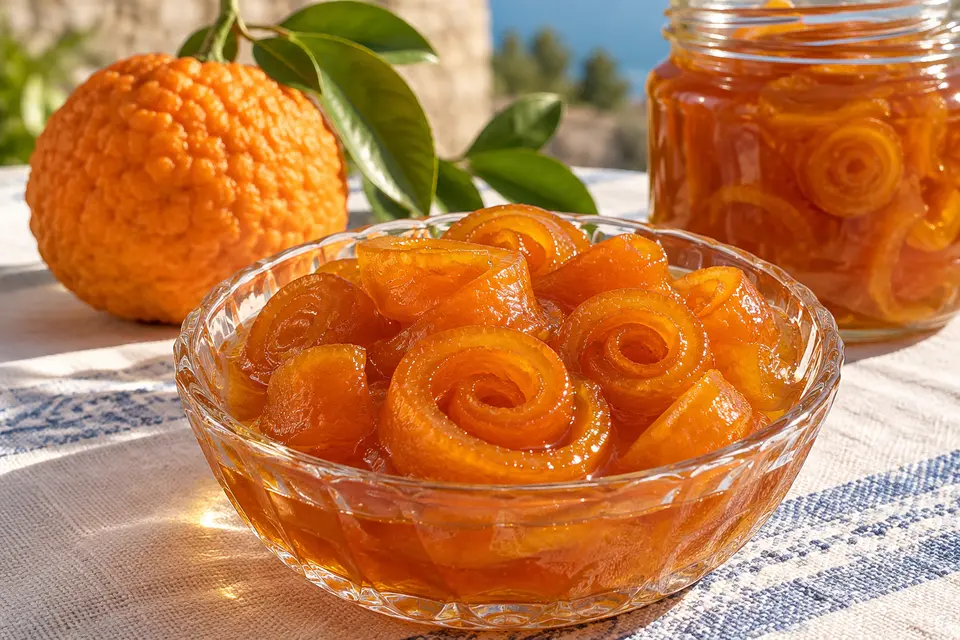
The Turkish Patent and Trademark Office registered Antalya Bergamot Kabuğu Reçeli as geographical indication no. 771 on 26 May 2021. Its specification names Antalya-grown local A-41 bergamot, harvested in January and February, and records more than a century of production in the province. The defining craft is visible in every piece: the outer yellow layer is grated away, the white pith is lightly trimmed, each peel panel is rolled and threaded on cotton, then boiled and soaked until its harsh bitterness has softened. The registered product must be made entirely within Antalya and finish at 67–69 °Brix. This recipe faithfully scales the official formula for a home kitchen; outside Antalya or without A-41 fruit, it is a respectful adaptation rather than the protected geographical product.
Antalya Bergamot Kabuğu Reçeli — Recipe Card
Antalya bergamot peel preserve with hand-rolled citrus ribbons
Makes 24 servings · Makes about three 240 ml jars; one serving is about 2 tablespoons.US cup = 240 ml · tablespoon = 15 ml · teaspoon = 5 ml. Cup and weight conversions are approximate. Australian cooks: use a 15 ml measuring tablespoon.
Ingredient quantities and servings are scaled. Cooking times, pan sizes, frying oil depth, and temperatures stay the same; cook larger batches as needed.
Ingredients
How to make Antalya Bergamot Kabuğu Reçeli
Prepare and weigh the peel
Scrub and dry the bergamots. Finely grate away the yellow outer flavedo without digging deeply into the white pith. Score each fruit from top to bottom into 6–8 panels, lift the peel from the flesh and lightly shave down the thick white albedo with a small sharp knife. Weigh 500 g (17.6 oz) of prepared peel; reserve the fruit for another use.
Roll and thread the panels
Roll each peel panel tightly into a short cylinder. With a clean large needle and food-safe unbleached cotton kitchen string, pierce the centre of each roll and thread the pieces closely together. Tie the ends securely, leaving enough string to lift each chain.
Boil until pliable
Put the peel chains in a wide nonreactive pot, cover generously with fresh water and bring to a boil. Simmer until a roll feels pliable when pressed but does not break apart; begin checking at 15 minutes because thickness and ripeness vary. Drain, rinse immediately under cold water and cool completely.
Soak away the harsh bitterness
Submerge the cooled peel chains in plenty of fresh cold water in a clean nonreactive container. Leave at cool room temperature for 3–4 days, changing the water 3–4 times each day. If the room is warmer than 21°C/70°F, refrigerate the container and allow extra time if needed. After 3 days, taste a tiny cooled edge; continue soaking until the bitterness is gentle, then drain thoroughly.
Start the syrup
Combine 500 g sugar and 250 ml water in a wide heavy saucepan. Warm over medium heat, stirring only until the sugar dissolves, then bring to a steady boil. Lower the drained peel chains carefully into the boiling syrup.
Cook to the traditional concentration
Boil gently, stirring occasionally so the rolls cook evenly. If using a refractometer, cool a small sample as its instructions require; at 60 °Brix stir in the lemon juice, then continue to 67–69 °Brix. Without a refractometer, add the lemon when the peel is translucent and the syrup has begun to thicken, then cook until a chilled spoonful falls in a slow glossy sheet. That visual test guides home texture but does not certify the protected Brix value.
Remove the strings and fill
Take the pan off the heat. With clean tongs and scissors, snip and pull out every piece of cotton string without unrolling the hot peel. Divide the rolls and syrup among clean heatproof jars, leaving about 1 cm (3/8 inch) of headspace, and close the lids. Do not invert the jars.
Cool and refrigerate
Let the closed jars cool for no longer than 2 hours, then refrigerate at 4°C/40°F or below. This home recipe is a refrigerator preserve and has not been validated for shelf-stable canning.
Bring this recipe to your kitchen with a printable copy.
Print recipeRecipe from MyTurkishRecipes · https://myturkishrecipes.com/antalya-bergamot-peel-preserve-turkish-recipe. Quantities reflect your selected serving scale. Cooking times are estimates; follow the doneness cues.
A few helpful kitchen notes
Protected identity
The registered Antalya product uses local A-41 bergamot grown in Antalya, completes every production stage within the province and finishes at 67–69 °Brix. Fruit grown elsewhere can make a fine home preserve, but it should not be presented as the protected geographical product.
Choosing bergamot
Use whole culinary bergamot with untreated, unwaxed peel. Bergamot essential oil, flavouring, ordinary lemon and sweet orange are not substitutes: they do not provide the same thick aromatic peel or the dish's identity.
Sugar and Brix
Keep the official one-to-one weight ratio of prepared peel to sugar. Reducing the sugar changes the syrup, texture and keeping quality. A refractometer is the only reliable way to verify the registered 67–69 °Brix endpoint.
Refrigerator storage
The geographical-indication document describes a controlled commercial hot-fill and inversion process. Home-preservation guidance does not treat inversion alone as a validated canning method, so this version is refrigerated for up to 3 weeks. Use a clean spoon and discard the entire jar if mold, unexpected bubbling, or a yeasty or alcoholic odor appears.
Dietary notes
The base recipe is vegan, vegetarian and made without gluten-containing ingredients. These labels describe the ingredients and do not guarantee freedom from cross-contact in packaged sugar or shared kitchens.
How to store and reheat Antalya Bergamot Kabuğu Reçeli
Cool the closed jars for no longer than 2 hours, then refrigerate at 4°C/40°F or below. Use within 3 weeks and return the jar to the refrigerator promptly after each serving. Always use a clean spoon. Discard the entire jar if you see mold, unexpected bubbles, leakage, or smell yeast, alcohol or any other spoilage. Do not store this batch at room temperature.
Antalya Bergamot Kabuğu Reçeli: questions and answers
Is bergamot peel preserve the same as marmalade?
No. Marmalade usually suspends chopped or shredded citrus peel in a gel. Antalya Bergamot Kabuğu Reçeli keeps distinct hand-rolled peel cylinders in a clear syrup and uses a multiday debittering soak.
Can I replace bergamot with lemon or orange?
Not without making a different preserve. Bergamot contributes a distinctive floral aroma, thick peel and controlled bitterness. Use true culinary bergamot; save lemon or bitter orange for their own traditional preserves.
Why does the peel soak for 3–4 days?
The official method uses the soak, with water changed 3–4 times daily, to draw out harsh bitterness after the peel has been boiled. Shortening it can leave the finished syrup aggressively bitter.