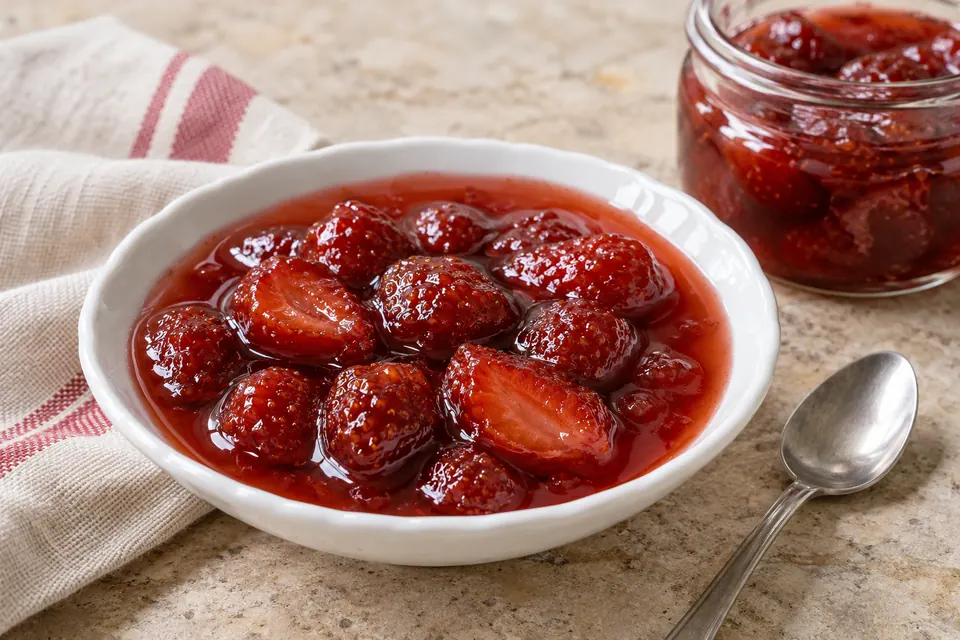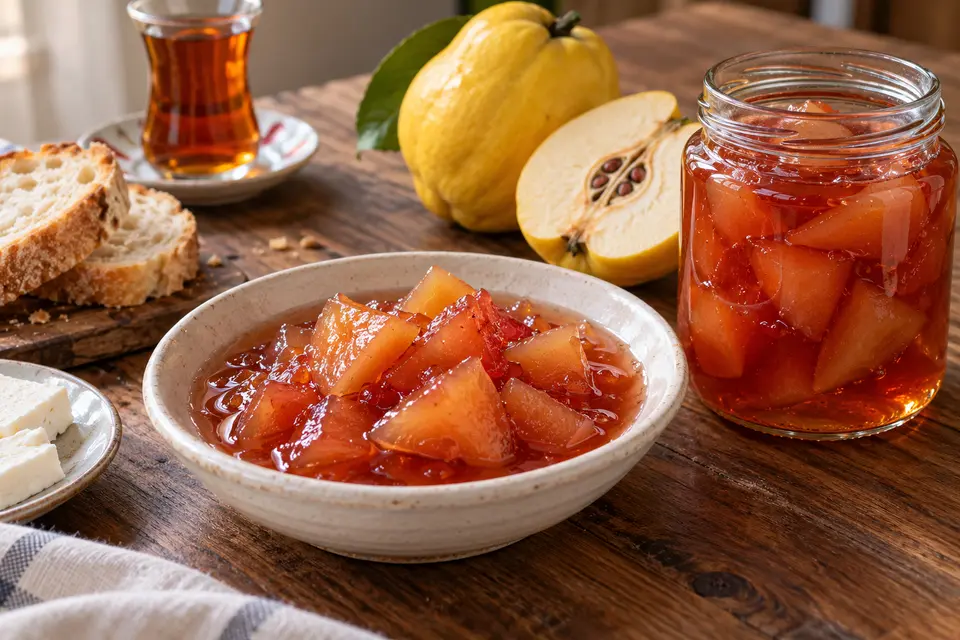
Reçel has a familiar place beside bread, cheese and tea at Turkish breakfast. GoTürkiye includes homemade jam among the essentials of the breakfast table and specifically names quince among preserves made from local produce on Aegean tables. A recipe recorded for Artvin by Türkiye's Culture Portal uses quince, sugar, water and lemon, with a slow cook that keeps recognizable fruit pieces. The recipe here preserves that simple character and adds conservative refrigerator-storage guidance for a home kitchen.
Ayva Reçeli — Recipe Card
Turkish quince preserve with lemon
Makes 40 servings · About 1.25 litres (5 cups), roughly three 450 ml jarsUS cup = 240 ml · tablespoon = 15 ml · teaspoon = 5 ml. Cup and weight conversions are approximate. Australian cooks: use a 15 ml measuring tablespoon.
Ingredient quantities and servings are scaled. Cooking times, pan sizes, frying oil depth, and temperatures stay the same; cook larger batches as needed.
Ingredients
How to make Ayva Reçeli
Prepare the jars and test plate
Wash three heatproof 450 ml jars and their lids in hot soapy water, rinse well and keep them warm. Place a small saucer in the freezer for the set test. These clean jars are storage containers only; this recipe is not a water-bath canning process.
Cut the quinces
Peel and core the quinces, then cut them into even 1.5 cm / 1/2-inch pieces. Weigh 1 kg / 2.2 lb of prepared fruit and place it in a wide, heavy-based saucepan.
Macerate with sugar
Scatter the sugar evenly over the quince. Cover and leave at cool room temperature for 2 hours; the fruit will release some juice and the sugar will begin to look damp.
Bring to a boil
Add the water and set the pan over medium heat. Stir gently until the visible sugar has dissolved, then bring the mixture to a steady boil. Skim off any pale foam that gathers on the surface.
Simmer until tender
Lower the heat and simmer uncovered for 45 to 55 minutes, stirring carefully every few minutes so the fruit stays intact and the base does not catch. The quince should become tender and translucent, and the syrup should deepen from gold toward amber or ruby; exact colour varies with the fruit.
Add lemon and test the syrup
Stir in the lemon juice for the final 5 minutes. Put a teaspoon of syrup on the frozen saucer, wait 30 seconds, then push it with a fingertip: it should move slowly and wrinkle faintly. If it runs like water, simmer for 3 to 5 minutes more and test again. Remove the pan from the heat before the syrup becomes stiff.
Fill, cool and refrigerate
Ladle the hot preserve into the warm jars, leaving about 2.5 cm / 1 inch at the top. Set them upright on a rack, loosely covered, for about 30 minutes; then close the lids and refrigerate, always within 2 hours of leaving the heat. Do not invert the jars and do not store them at room temperature.
Bring this recipe to your kitchen with a printable copy.
Print recipeRecipe from MyTurkishRecipes · https://myturkishrecipes.com/turkish-quince-preserve-ayva-receli. Quantities reflect your selected serving scale. Cooking times are estimates; follow the doneness cues.
A few helpful kitchen notes
Refrigerator preserve
This formula has not been validated for shelf-stable canning. Keep every jar at 4°C / 40°F or below; do not rely on a vacuum seal, hot filling or jar inversion for room-temperature storage.
Texture and colour
Quince supplies natural pectin, so the syrup continues to thicken as it cools. A golden result is as valid as a ruby one; variety, ripeness, pan shape and cooking time all affect the colour.
Sugar changes
Do not simply reduce or replace the sugar: doing so changes the set, yield and keeping quality. For a lower-sugar spread, use a separately tested refrigerator or freezer-jam formula designed for that purpose.
Optional aroma
For a subtle variation, simmer 3 whole cloves or two thin strips of lemon zest with the syrup and remove them before filling the jars; the base recipe remains lemon-bright and unspiced.
How to store and reheat Ayva Reçeli
Refrigerate at 4°C / 40°F or below and use within 3 weeks. Spoon out only what you need with a clean utensil and return the jar promptly to the refrigerator. Discard the entire jar if you see mould, bubbling or yeast growth, or notice a fermented, alcoholic or otherwise off odour. This preserve is not shelf-stable and must not be stored at room temperature.
Ayva Reçeli: questions and answers
Why did my quince preserve stay golden instead of turning red?
Quince colour varies with variety, ripeness, acidity, oxygen exposure and cooking time. Tender translucent fruit and a syrup that passes the chilled-plate test matter more than achieving a particular shade.
What if the syrup becomes too thick?
After chilling, loosen only the portion you plan to serve with a teaspoon or two of hot water. Avoid adding water to the whole storage jar, which would alter its keeping quality.
Can I water-bath can this recipe?
No. The proportions and method here are written for refrigerator storage, not validated shelf-stable canning. Use a research-tested quince preserve or jelly recipe with its exact jar size and processing time if you want a pantry product.
How is Ayva Reçeli served?
Offer a small spoonful with fresh bread at breakfast, alongside white cheese or kaymak, or use it as a sweet accent for plain yogurt.