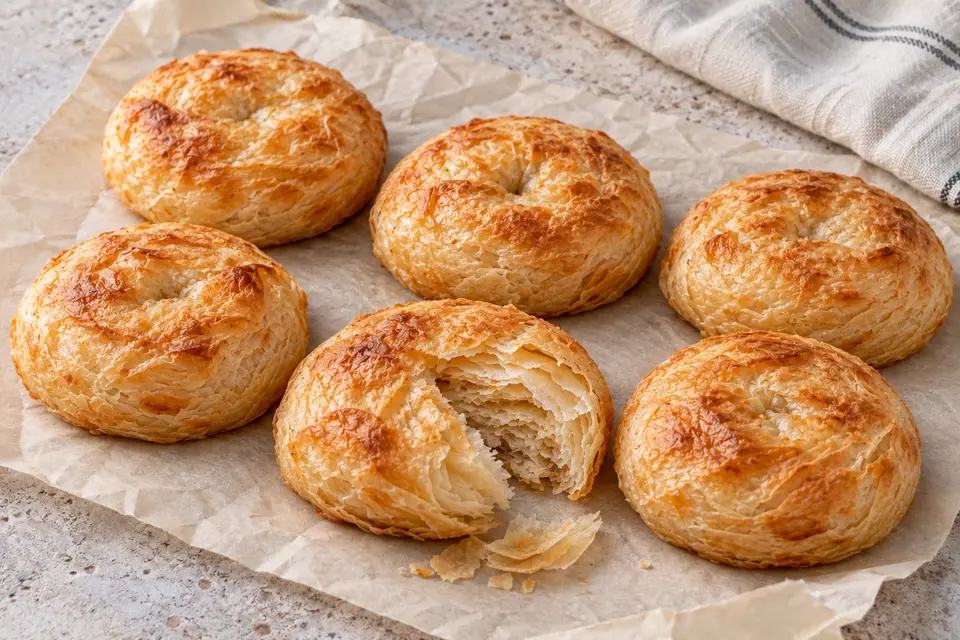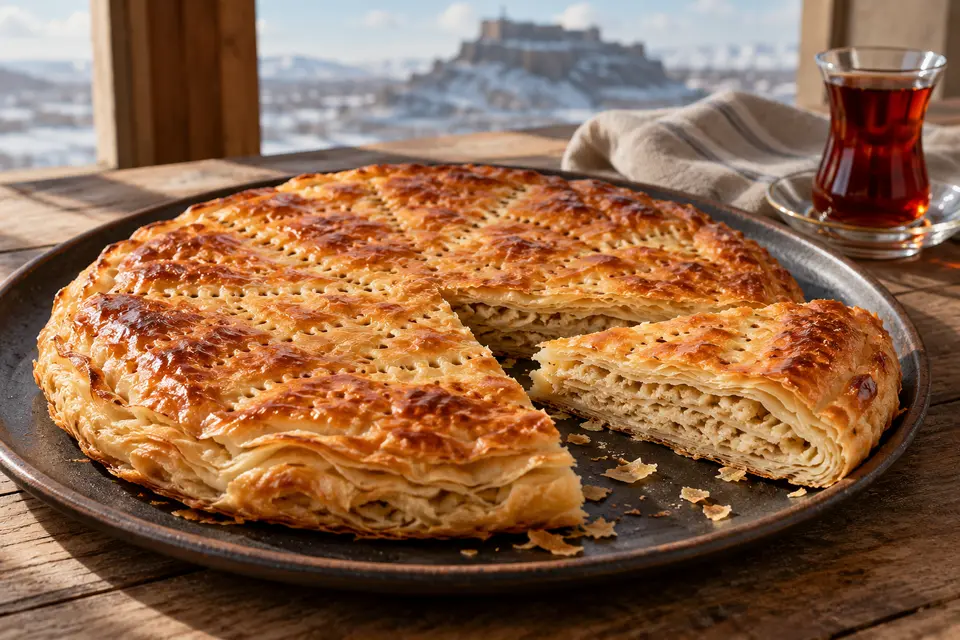
Kars Ketesi is protected in Türkiye as geographical indication no. 1366. The registry describes round or square pastries with a yellow-brown crust and a friable texture created by repeated oiling and folding. It recognizes savory, sweet and ginger fillings, with coarse walnuts as an option. This home-scaled recipe follows the savory version and preserves the registered method's 3 mm sheets, envelope fold, flour filling, fork-pricked top and long cooling period.
Kars Ketesi — Recipe Card
Kars-style layered pastry with a savory flour filling
Makes 12 servings · Makes 6 large pastries, each about 20–22 cm / 8–9 inches across; slice each pastry into wedges to serve 12.US cup = 240 ml · tablespoon = 15 ml · teaspoon = 5 ml. Cup and weight conversions are approximate. Australian cooks: use a 15 ml measuring tablespoon.
Ingredient quantities and servings are scaled. Cooking times, pan sizes, frying oil depth, and temperatures stay the same; cook larger batches as needed.
Ingredients
How to make Kars Ketesi
Mix and proof the dough
Stir the lukewarm milk, yeast and sugar together. Add 390 g / 13.8 oz of the flour and 2 g / about 1/3 teaspoon of the salt. Knead for 8–10 minutes, until very soft, smooth and only slightly tacky. Cover and leave in a warm place for about 1 hour, until visibly doubled.
Prepare the savory filling
Combine 30 g / 1.1 oz of the clarified butter with 30 ml / 2 tablespoons of the sunflower oil and reserve this for brushing the sheets. Warm the remaining 120 g clarified butter and 120 ml / 1/2 cup oil just until fluid. Remove from the heat, whisk in the remaining 60 g / 2.1 oz flour for 5–10 seconds, then stir in the remaining 3 g / about 1/2 teaspoon salt. Cool until thick but spreadable.
Roll the sheets
Divide the risen dough into 6 equal pieces of 130–140 g / 4.6–4.9 oz and round them. Beginning with the first piece, dust the worktop very lightly with cornstarch and roll to an approximately 3 mm / 1/8-inch-thick circle, 55–60 cm / 22–24 inches across. Keep the other pieces covered.
Fold, fill and shape
Brush the entire sheet sparingly with the reserved butter-oil mixture. Fold four sides inward to make an envelope. Place about 50 g / 1.8 oz of filling in the center and fold the corners over it into a closed parcel. Turn seam-side down on a parchment-lined tray, then press from the center outward to an even 20–22 cm / 8–9-inch round. Pierce all over with a fork. Repeat with the remaining dough.
Glaze and bake
Heat the oven to 190°C / 375°F. Brush the tops evenly with beaten egg. Bake for 40–45 minutes, rotating the trays halfway if using two racks, until the pastries are deep golden-brown, crisp at the edges and fully baked through.
Cool before slicing
Transfer the pastries to cloth-lined racks or clean kitchen towels in a single layer. Let them cool for 6 hours without stacking; this allows the fragile layers and savory filling to settle. Slice into wedges with a serrated knife.
Bring this recipe to your kitchen with a printable copy.
Print recipeRecipe from MyTurkishRecipes · https://myturkishrecipes.com/turkish-layered-savory-pastry-kars-ketesi. Quantities reflect your selected serving scale. Cooking times are estimates; follow the doneness cues.
A few helpful kitchen notes
Traditional version
The Kars registration allows savory, sweet or ginger fillings and optional coarsely chopped walnuts. This recipe presents the savory flour filling; adding cheese or meat would make a different pastry.
Clarified butter
Sadeyağ is clarified butter. Ghee is the closest widely available substitute. Ordinary butter contains water and will soften the crisp layers, so clarify it first rather than swapping it one for one.
Dietary and allergens
Vegetarian. Contains wheat, milk and egg and is not gluten-free. Use pasteurized milk and check packaged ghee if allergen labeling is important.
Raw-flour safety
Do not taste the dough or filling before baking. Flour is a raw food; wash hands, bowls, utensils and the worktop after contact, and bake every pastry completely.
How to store and reheat Kars Ketesi
Cool completely before storing and do not stack while warm. For conservative home storage, refrigerate airtight at 4°C / 40°F or below for up to 4 days, or freeze well wrapped for up to 2 months. Reheat from chilled at 180°C / 350°F for 10–12 minutes; thaw frozen pastries overnight in the refrigerator before reheating.
Kars Ketesi: questions and answers
What is inside Kars Ketesi?
In this savory registered style, the filling is a brief mixture of clarified butter, sunflower oil, flour and salt. It should taste rich and toasted but remain crumbly; there is no cheese or meat.
Can I use ordinary butter instead of ghee?
Clarify ordinary unsalted butter first, then weigh the clear butterfat. Its milk solids and water would otherwise brown too quickly and reduce the pastry's clean, flaky texture.
Why does Kars Ketesi cool for six hours?
The protected method specifies a six-hour cooling period with the pastries kept separate. The rest firms the fat, settles the flour filling and helps the fragile layers slice without collapsing.