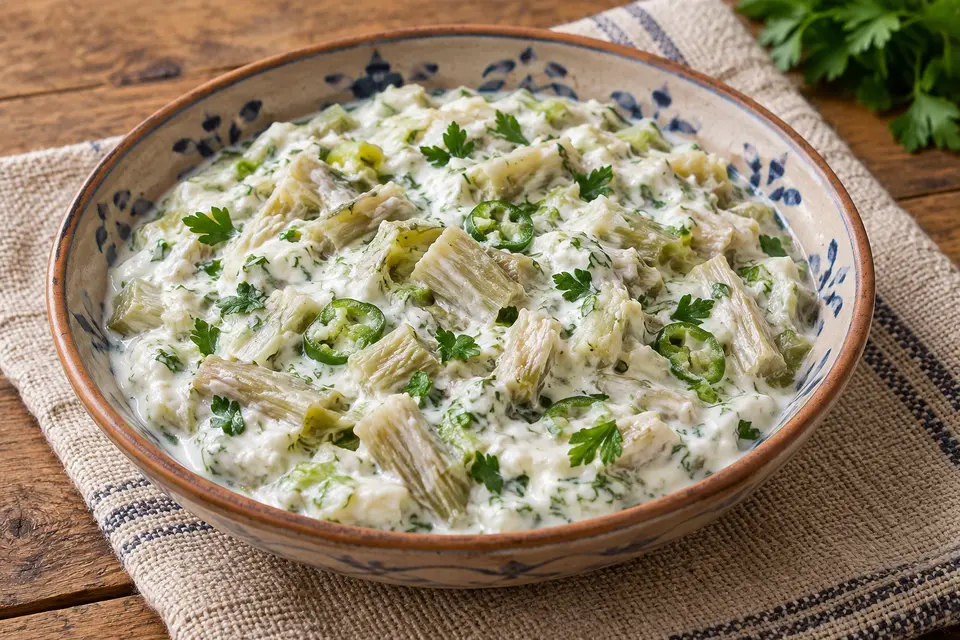
Türkiye’s Culture Portal records this four-part preparation through the Hakkâri Provincial Directorate of Culture and Tourism: boiled kenger, strained yogurt, green peppers and parsley. The Ministry of Agriculture and Forestry’s national food database identifies kenger as Gundelia tournefortii L., while a ministry research publication notes that its young underground shoots are eaten as a vegetable and used boiled in regional dishes. This version keeps the documented quantities and method, adding only measured boiling water and practical doneness cues for a home kitchen.
Kenger Cacığı — Recipe Card
Hakkâri Kenger and Strained Yogurt Meze
Makes 6 servingsUS cup = 240 ml · tablespoon = 15 ml · teaspoon = 5 ml. Cup and weight conversions are approximate. Australian cooks: use a 15 ml measuring tablespoon.
Ingredient quantities and servings are scaled. Cooking times, pan sizes, frying oil depth, and temperatures stay the same; cook larger batches as needed.
Ingredients
How to make Kenger Cacığı
Prepare the kenger
Use prepared edible kenger shoots from a trusted market or grower; do not identify or forage wild plants from this recipe. Rinse the shoots under running water without soap, trim away any fibrous or damaged parts and cut them into 2 cm/¾-inch pieces.
Boil until tender
Bring the water to a full boil in a medium saucepan. Add the kenger, lower to a steady simmer and cook for 15–20 minutes, or until the thickest piece is easily pierced with a small knife and no hard fibrous core remains.
Drain and cool
Tip the kenger into a fine sieve and leave it to drain and cool completely for about 20 minutes. Spread the pieces on a clean plate if they are holding steam; do not rinse away their flavour after cooking.
Prepare the greens
Finely chop the mild green peppers and parsley. Check the peppers before using: if they are unexpectedly hot, use less so the yogurt does not hide how spicy the finished bowl will be.
Fold and serve
Stir the strained yogurt just until smooth. Fold in the completely cooled kenger, green pepper and parsley until evenly distributed. Spoon into a shallow bowl and serve cool; the documented Hakkâri version needs no cucumber, garlic, mint or added water.
Bring this recipe to your kitchen with a printable copy.
Print recipeRecipe from MyTurkishRecipes · https://myturkishrecipes.com/turkish-kenger-yogurt-meze-kenger-cacigi. Quantities reflect your selected serving scale. Cooking times are estimates; follow the doneness cues.
A few helpful kitchen notes
What kenger is
Kenger is Gundelia tournefortii L., a plant in the daisy family. The edible young underground shoots are used as a spring vegetable in regional Turkish cooking; buy a food-grade prepared product rather than relying on wild identification.
Using jarred kenger
If fresh prepared kenger is unavailable, use 200 g well-drained plain jarred kenger intended for eating. Rinse only if the label describes a strong brine, drain thoroughly and skip the boiling step. This is a practical substitution, not the fresh-shoot method documented for Hakkâri.
Heat level
Mild when made with mild Turkish green peppers. For a hotter bowl, replace one pepper with a hot sivri pepper; check its heat before chopping because green peppers vary considerably.
Allergens
Contains milk in the strained yogurt. Check the labels of yogurt and any packaged kenger for allergens and cross-contact information. This recipe does not make a gluten-free claim.
How to store and reheat Kenger Cacığı
Serve promptly or refrigerate in a covered container within 2 hours at 4°C/40°F or below. For the best texture and freshness, eat within 2 days. Keep it cold while serving, discard any portion left above refrigerator temperature for more than 2 hours, and do not freeze because the yogurt can separate.
Kenger Cacığı: questions and answers
Is Kenger Cacığı the same as cucumber cacık?
No. Both use yogurt, but this Hakkâri dish contains boiled kenger, green pepper and parsley. The documented version does not include cucumber, garlic, mint or added water.
Which part of kenger is used?
Use cleaned, edible young shoots sold for cooking. The Turkish source calls the prepared ingredient kenger pancarı; it is boiled until tender before being cooled and mixed with yogurt.
Why did my yogurt become watery?
The kenger was probably still warm or held excess cooking water, or the yogurt was not fully strained. Cool and drain the vegetable completely and use thick strained yogurt straight from the refrigerator.