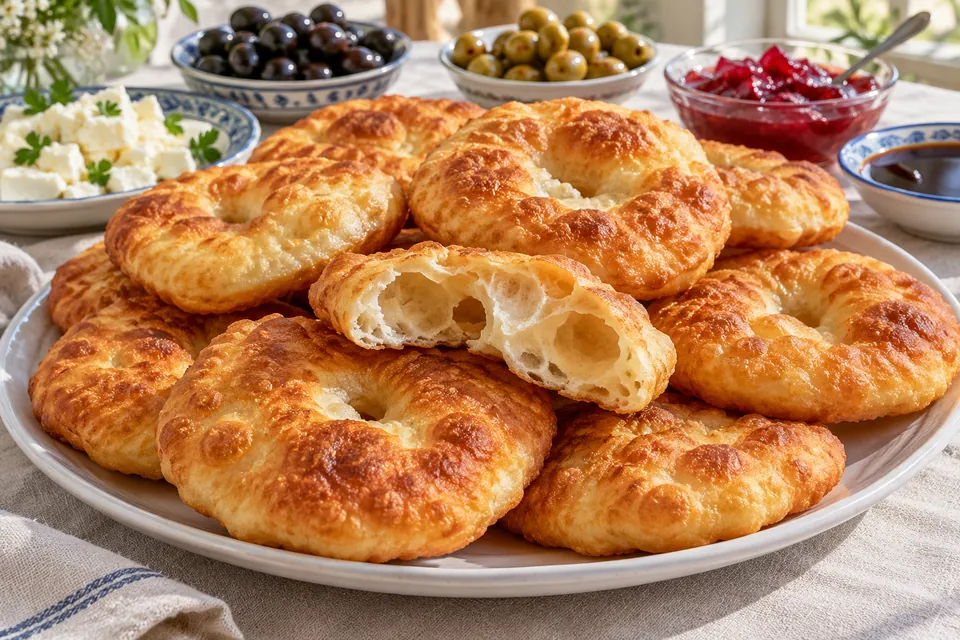
Regional records show both a shared structure and local differences. The Amasya version mixes flour, dry yeast, salt and warm water, rests the dough for about an hour, flattens it to roughly 5 mm and serves it with grape molasses, especially during Ramadan. Afyonkarahisar records bread dough flattened by hand and fried, with optional nigella seeds, then served alongside cheese, olives, pickles, halva, jam or molasses. In Antalya, pişi or bişi also appears as a food prepared and shared for special days and community gatherings. This recipe follows the plain yeast-dough structure while giving precise home-kitchen quantities and frying cues.
Pişi — Recipe Card
Turkish fried yeast dough
Makes 12 servings · Makes 12 medium pişi, about 10–12 cm (4–5 in) wideUS cup = 240 ml · tablespoon = 15 ml · teaspoon = 5 ml. Cup and weight conversions are approximate. Australian cooks: use a 15 ml measuring tablespoon.
Ingredient quantities and servings are scaled. Cooking times, pan sizes, frying oil depth, and temperatures stay the same; cook larger batches as needed.
Ingredients
How to make Pişi
Combine the dry ingredients
Put the flour, instant yeast and salt in a large bowl and whisk to distribute them evenly.
Mix and knead
Pour in the lukewarm water and mix until no dry flour remains. Knead on a lightly floured surface for 8–10 minutes, until the dough is smooth, elastic and soft. It should feel slightly tacky but should not flow; add flour only 1 tablespoon at a time if it is impossible to handle.
Let the dough rise
Place the dough in a lightly oiled bowl, cover and leave in a warm, draft-free place for about 60 minutes, until roughly doubled in volume.
Divide and rest
Gently deflate the dough and divide it into 12 equal pieces, about 70 g/2.5 oz each. Shape them into balls, cover and rest for 10 minutes so they relax and stretch without springing back.
Heat the frying oil
Pour enough oil into a deep, heavy pan to make a 4–5 cm/1½–2 in layer, without filling the pan more than halfway. Heat to 175°C/350°F. Keep water away from the oil and never leave the pan unattended.
Shape and fry
Lightly oil your fingertips. Flatten one ball into a round 10–12 cm/4–5 in wide and about 5 mm/¼ in thick; make a small opening in the center. Lower it carefully into the oil away from you. Fry one or two at a time for 60–90 seconds per side, turning once, until puffed and evenly deep golden. Keep the oil between 170–180°C/340–355°F.
Drain and serve
Lift out with a slotted spoon and drain on a rack set over a tray; paper towel may be placed under the rack. Let the pişi stand for 2–3 minutes because the interior is very hot, then serve warm.
Bring this recipe to your kitchen with a printable copy.
Print recipeRecipe from MyTurkishRecipes · https://myturkishrecipes.com/turkish-fried-dough-pisi. Quantities reflect your selected serving scale. Cooking times are estimates; follow the doneness cues.
A few helpful kitchen notes
Regional serving ideas
Amasya records pişi with grape molasses, while the Afyonkarahisar account lists cheese, olives, pickles, halva, jam and molasses. Choose a few accompaniments rather than treating every item as mandatory.
Nigella-seed variation
For the optional Afyonkarahisar-style accent, knead 1 teaspoon nigella seeds into the dough after it becomes smooth. The frying method stays the same.
Dietary notes
The base recipe is vegan and vegetarian but contains wheat and gluten. Shared frying oil can introduce dairy, egg or other cross-contact, so use fresh dedicated oil when this matters.
Heat level
No added chili. Serve pul biber separately if guests want heat; adding it changes the plain base recipe.
How to store and reheat Pişi
Pişi is best while warm. Cool leftovers on a rack, place them in a covered shallow container and refrigerate within 2 hours. Use within 3–4 days. Reheat only what you need in a 180°C/350°F oven for 6–8 minutes, until the center reaches 74°C/165°F. Freeze cooled pieces with parchment between them for up to 2 months; thaw in the refrigerator before reheating.
Pişi: questions and answers
Why did my pişi not puff?
The dough may not have risen fully, the rounds may be too thick or the oil may be below 170°C/340°F. Let the dough double, keep the rounds near 5 mm/¼ in and allow the oil to recover between batches.
Can I make this version without yeast?
Not as a direct swap. Some regional fried doughs use yogurt, egg or baking soda, but they need different proportions and resting times. Use a complete recipe for that style rather than replacing the yeast here.
Can I bake or air-fry the dough?
Those methods produce a different crust and do not reproduce traditional oil-fried pişi. For this recipe, shallow deep-frying at a controlled temperature gives the expected puff and texture.