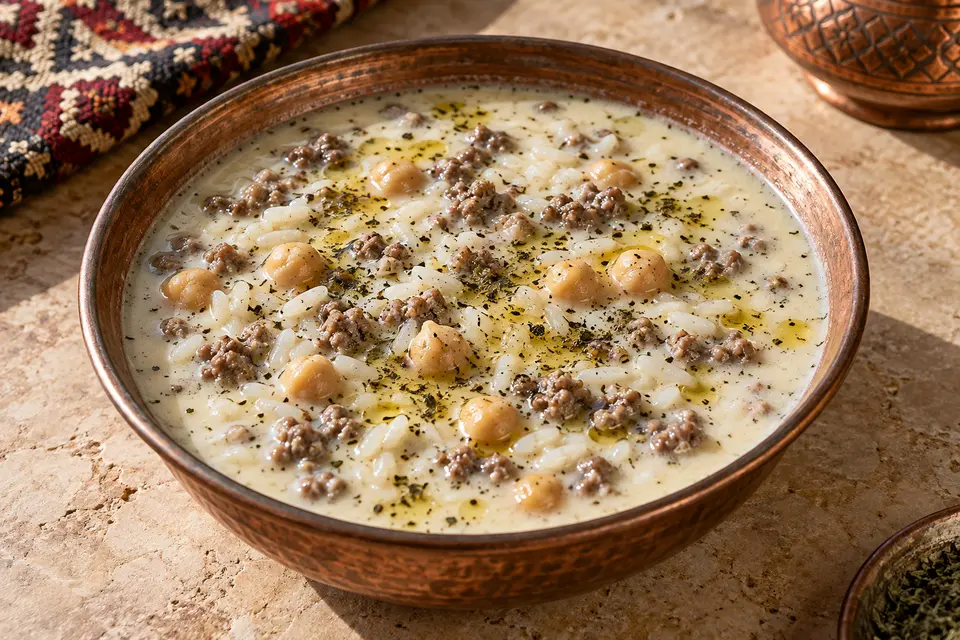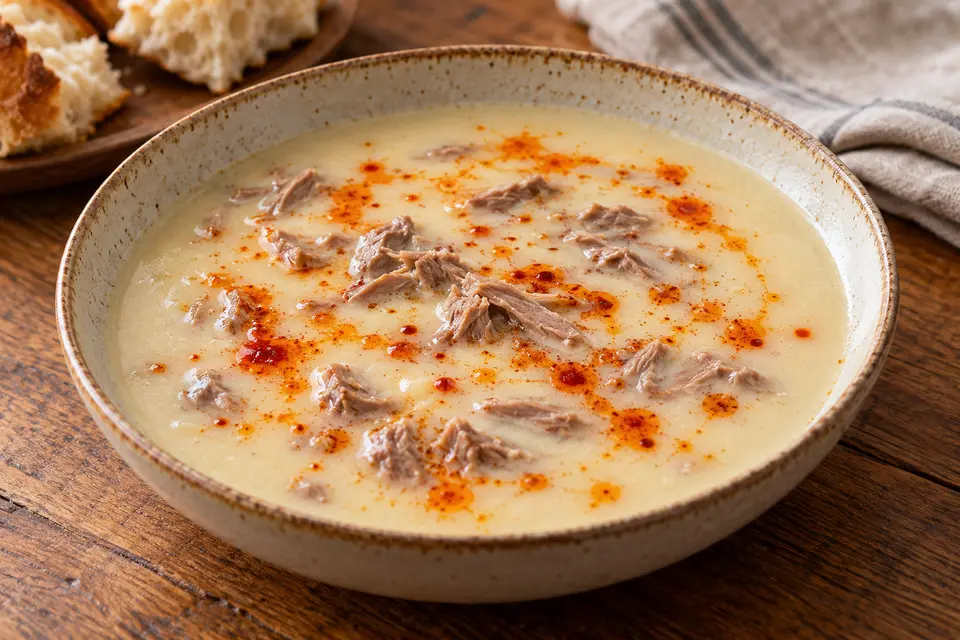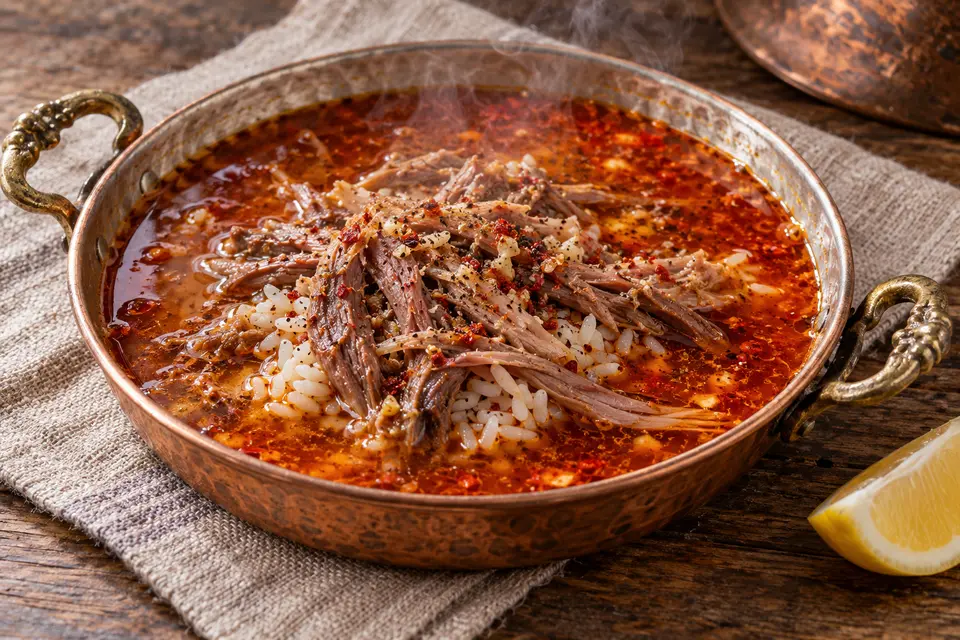
Registered by TÜRKPATENT as geographical indication no. 207, Antep Beyranı has a documented commercial history in Gaziantep dating to 1885. The specification defines the dish through long-cooked sheep meat and marrow bones, unsalted oil-free rice called kel pilav, crushed garlic, red pepper and a final high-heat boil in a copper sahan. It may be served dabanı yağlı, with lamb fat in the base, or dabanı yağsız, without it. This home version preserves those elements while avoiding the intentional flare that professional beyran burners can create.
Antep Beyranı — Recipe Card
Gaziantep-Style Spicy Lamb Broth with Rice and Garlic
Makes 6 servingsUS cup = 240 ml · tablespoon = 15 ml · teaspoon = 5 ml. Cup and weight conversions are approximate. Australian cooks: use a 15 ml measuring tablespoon.
Ingredient quantities and servings are scaled. Cooking times, pan sizes, frying oil depth, and temperatures stay the same; cook larger batches as needed.
Ingredients
How to make Antep Beyranı
Soak the lamb and bones
Put the lamb and bones in a nonreactive container, cover with additional cold water and refrigerate for 1–3 hours. Change the water two or three times until it is much less red. Drain and rinse; keep the meat cold throughout this step.
Start and skim the broth
Put the drained lamb and bones in a large heavy stockpot with 3.5 litres (14 1/2 cups) of the measured water. Bring slowly just to a boil. Skim every trace of grey foam, then add the optional lamb fat and skim once more. Add the whole onions, the whole lemon and 8 g (1 1/3 teaspoons) of the salt.
Simmer until the meat fibres separate
Cover partially and maintain the gentlest simmer for 10–12 hours, adding a little hot water only if the bones become exposed. For home safety, cook during waking hours or use a covered oven-safe pot in a 135°C/275°F oven; never leave an open flame unattended. The lamb will pass the 63°C/145°F minimum early in cooking and should finish completely tender.
Strain, shred and hold the broth
Discard the onions and whole lemon. Lift out the meat and bones, then strain the broth through a fine sieve. Skim and reserve up to 60 g (4 1/4 tablespoons) of the clear lamb fat for a dabanı yağlı serving, or discard it for dabanı yağsız. While the meat is still warm, remove every bone, tendon and large piece of fat and pull the meat into fine fibres. Keep the broth above 60°C/140°F if assembling immediately.
Make the kel pilav
Bring the remaining 1.5 litres (6 1/4 cups) measured water to a boil in a separate saucepan. Add the rice without salt or fat and boil for 10–12 minutes, until just tender but not soft. Drain very well. You should have roughly 360–420 g cooked rice.
Assemble the portions
For each serving, put 10 g (about 2 teaspoons) reserved lamb fat in a small copper sahan or sturdy 18–20 cm (7–8-inch) skillet, or omit it for the fat-free version. Add 60–70 g cooked rice and cover it with 60–70 g shredded lamb. Scatter over 10 g crushed garlic, 10 g red pepper flakes and 3 g black pepper. Repeat in batches if you do not have six pans.
Boil hard and serve immediately
Set one assembled pan over medium-high heat. Carefully ladle in 300–350 ml (1 1/4–1 1/2 cups) hot broth from the side; do not pour liquid into smoking fat or attempt to create a flame. Bring to a vigorous rolling boil for 2–3 minutes, taste and add a little of the remaining salt if needed. Transfer the hot pan to a heatproof board and serve at once with a lemon wedge. Repeat for the remaining portions.
Bring this recipe to your kitchen with a printable copy.
Print recipeRecipe from MyTurkishRecipes · https://myturkishrecipes.com/spicy-lamb-and-rice-soup-antep-beyrani. Quantities reflect your selected serving scale. Cooking times are estimates; follow the doneness cues.
Make it work in your kitchen
Ingredient Substitutions
These swaps change flavor or texture as described. Keep the original ingredients for the closest version of the dish.
Pul biber
Use the same amount of mild paprika for color and a gentler flavor. For heat, add a small pinch of chili flakes, then taste; chili flakes can be much hotter.
A few helpful kitchen notes
Use lamb, not beef
The registered Antep method specifies sheep meat from the neck and shoulder with plentiful marrow bones. Beef or chicken produces a different broth and should not be presented as Antep Beyranı.
Dabanı yağlı or yağsız
Gaziantep service recognizes both a base enriched with reserved lamb fat and a version without it. The optional fat changes richness, not the identity of the garlic, pepper, rice and lamb broth.
Heat level
Spicy: the registered lower range is about 10 g red pepper flakes per serving. For a milder household variation, reduce this to 3–5 g per serving and offer extra pul biber at the table; the result will be less fiery than the registered profile.
Dietary notes
The base ingredients contain no wheat. For a gluten-free serving, use plain rice and single-ingredient spices with suitable labeling where needed; this does not guarantee absence of cross-contact or certification for coeliac disease.
High-heat safety
Professional beyran shops use specialized burners and long-handled tongs. At home, use a stable pan, add broth before the fat smokes, keep your face and hands away from steam, and never imitate the traditional flare.
How to store and reheat Antep Beyranı
For later use, cool broth, shredded lamb and rice separately in shallow containers within 2 hours and refrigerate at 4°C/40°F or colder for up to 3 days. Bring the broth to a full boil and reheat the lamb and rice to 74°C/165°F when assembling. Do not store finished portions in copper pans.
Antep Beyranı: questions and answers
Why is the rice cooked separately for Beyran?
The plain, unsalted and oil-free rice is called kel pilav. Cooking it separately keeps the broth clear and lets each portion receive the correct amount before the final boil.
Do I need a copper sahan?
Copper is part of the registered presentation and transfers heat very quickly. A small heavy stainless-steel skillet is the safest practical substitute at home; use copper only if it is food-safe and properly lined.
Can I reduce the red pepper?
Yes, but Antep Beyranı is characteristically hot. Use 3–5 g per serving for a milder variation and keep the full amount available at the table.
Can I make the broth a day ahead?
Yes. Strain it, cool it rapidly in shallow containers and refrigerate it separately from the shredded meat and rice. Reheat the broth to a full boil before assembling the portions.