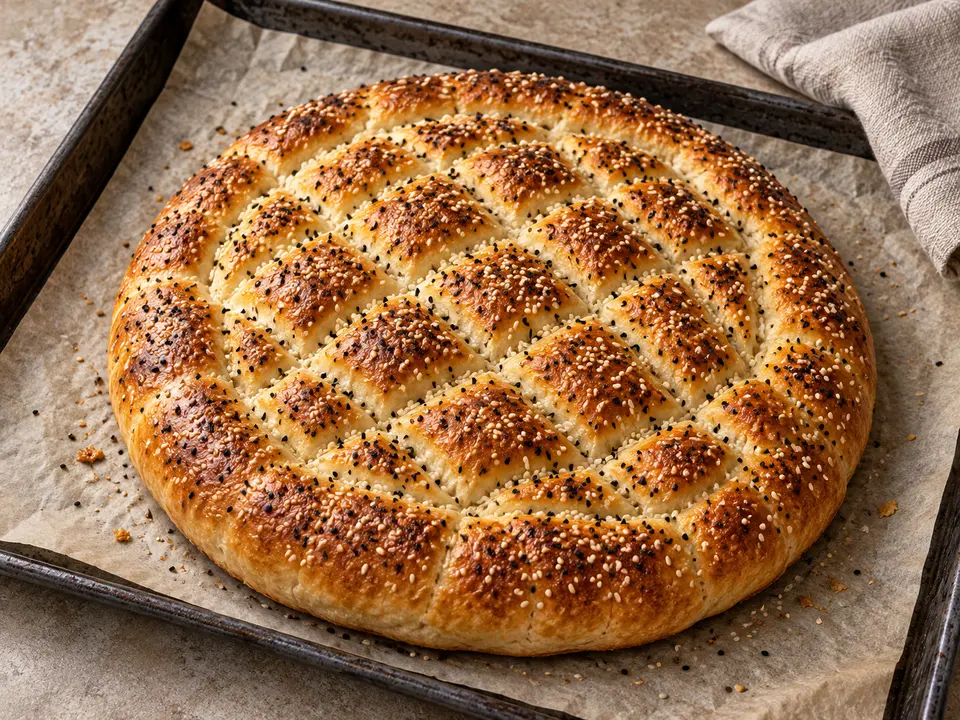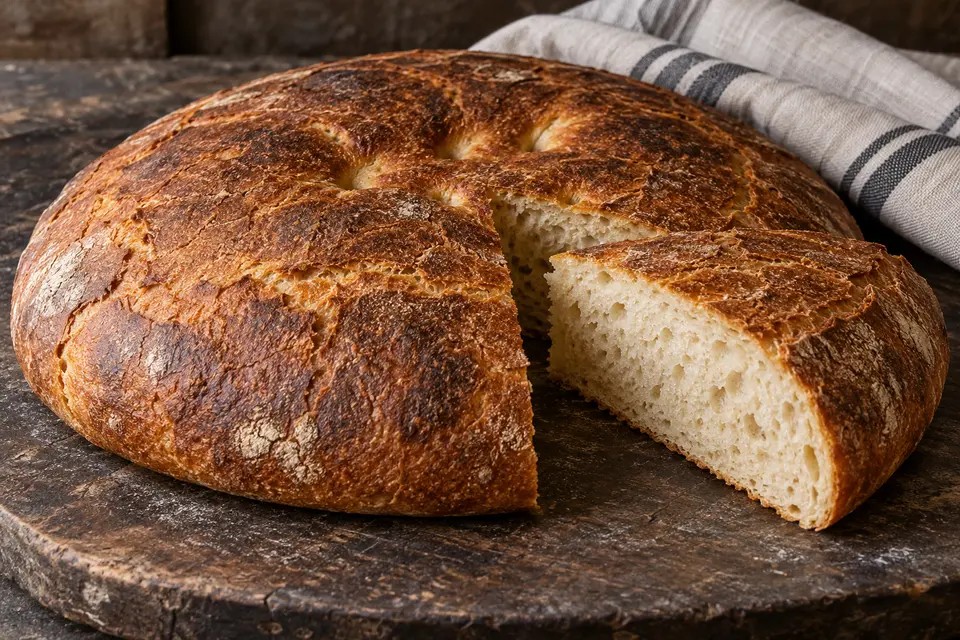
Registered in 2018 as geographical indication no. 371, the bread belongs to Afyonkarahisar and is traditionally made with local wheat flour and boiled local potatoes, then baked slowly on the floor of a wood-fired stone oven. The official formula uses 25–30% cooked potato and 8–10% sourdough relative to the flour, with no oil or sugar. A baking stone and a falling oven temperature reproduce part of that baking pattern at home, but bread made outside the registered area is a respectful home adaptation rather than the protected local product.
Afyonkarahisar Patatesli Ekmeği — Recipe Card
Afyonkarahisar sourdough potato bread
Makes 16 servings · 1 large 1.5 kg (3.3 lb) loaf, about 16 slicesUS cup = 240 ml · tablespoon = 15 ml · teaspoon = 5 ml. Cup and weight conversions are approximate. Australian cooks: use a 15 ml measuring tablespoon.
Ingredient quantities and servings are scaled. Cooking times, pan sizes, frying oil depth, and temperatures stay the same; cook larger batches as needed.
Ingredients
How to make Afyonkarahisar Patatesli Ekmeği
Build the overnight dough
The evening before baking, whisk the active starter into 120 ml (1/2 cup) of the water. Mix in 120 g (4.2 oz) of the flour and 2 g (a scant 1/3 teaspoon) of the salt. Knead briefly to a soft dough, cover, and ferment at a moderate room temperature for 8–12 hours, until aerated and pleasantly sour rather than collapsed.
Prepare the potato
If not already prepared, boil peeled floury potatoes in unsalted water until a knife passes through easily, 15–20 minutes. Drain well, cool, weigh 225 g (8 oz), and mash or rice them until no pieces remain. Do not use potato flour or instant potato flakes.
Mix the main dough
Combine the remaining 680 g (24 oz) flour, the smooth potato and remaining 10 g (1 2/3 teaspoons) salt in a large bowl. Add the overnight dough and 280 ml (1 cup plus 2 tablespoons) of the remaining water. Mix, squeeze and fold for 15–20 minutes, adding the final 40 ml (2 tablespoons plus 2 teaspoons) water gradually only as the flour accepts it. The finished dough should be cohesive and elastic but much softer and stickier than an ordinary boule dough.
Let the dough rise
Cover and ferment at room temperature for 1–2 hours. It is ready when visibly expanded and a wet fingertip indentation slowly begins to fill. Do not wait for the very soft dough to double completely.
Heat the baking surface
At least 60 minutes before baking, place a baking stone or steel in the lower-middle oven and heat to 250°C / 480°F. Put a sturdy empty metal pan on the lowest rack for steam. Keep a kettle of water ready.
Shape and proof
Scatter the bran over a sheet of parchment or a floured peel. With wet hands and a wet scraper, turn the dough onto it and draw the edges underneath to make one broad, low round weighing about 1.5 kg (3.3 lb). Cover loosely and proof for 30–60 minutes, until the round looks swollen but still holds its outline.
Press and bake
With damp fingertips, make five shallow presses around the center so the thick loaf bakes evenly; do not slash it like a tall boule. Slide the loaf and parchment onto the hot stone. Carefully pour 240 ml (1 cup) boiling water into the metal pan, close the door, and reduce the oven to 230°C / 445°F. Bake 20 minutes, remove the steam pan, lower to 200°C / 390°F, and bake for another 55–70 minutes. Rotate once if needed. The loaf should be deeply browned, feel firm underneath, and register 96–98°C / 205–208°F at the center.
Cool before slicing
Move the loaf to a rack and drape it loosely with a clean cloth for the first hour, echoing the traditional covered rest. Let it cool for at least 2 hours in total before slicing so the potato-rich crumb can set. Cool completely before wrapping.
Bring this recipe to your kitchen with a printable copy.
Print recipeRecipe from MyTurkishRecipes · https://myturkishrecipes.com/turkish-sourdough-potato-bread-afyonkarahisar-patatesli-ekmegi. Quantities reflect your selected serving scale. Cooking times are estimates; follow the doneness cues.
A few helpful kitchen notes
Registered proportions
The geographical-indication record specifies boiled potato at 25–30%, sourdough at 8–10%, water at 55–60% and salt at 1.5% relative to flour. This scaled loaf remains within those ranges; starter hydration and potato moisture can still change how much of the reserved water the dough needs.
Traditional versus home baking
The protected bread is made in Afyonkarahisar as a 1.5–2 kg round and bakes for 60–120 minutes on a wood-fired stone-oven floor. A thoroughly preheated stone or steel, initial steam and a falling home-oven temperature are practical approximations, not a claim of geographical-indication production.
Dietary notes
The base recipe is vegan and contains wheat gluten. Wheat bran and an established wheat sourdough culture also contain gluten; this is not suitable for a gluten-free adaptation.
Flour safety
Flour is a raw food. Do not taste the unbaked dough, and wash hands, tools and work surfaces after handling flour. Bake the center fully before eating.
How to store and reheat Afyonkarahisar Patatesli Ekmeği
Cool completely before wrapping. Keep the loaf in a bread bag or airtight container at cool room temperature for 2–3 days; discard it if mold appears. For longer keeping, slice, wrap well and freeze for up to 2 months. Thaw at room temperature and refresh slices in a 180°C / 350°F oven for 5–8 minutes.
Afyonkarahisar Patatesli Ekmeği: questions and answers
Can I use instant mashed potato?
No. The registered method uses boiled potato mashed so smoothly that no pieces remain; potato flour or instant flakes change both the moisture and the character of the bread.
Why is the dough so sticky?
The traditional dough is intentionally very soft. Potato and the relatively high water level give the baked loaf its resilient, sponge-like crumb. Wet hands and a scraper are better than adding extra flour.
Can I bake a smaller loaf?
Yes, divide the dough in half after bulk fermentation. Proof each broad round separately and begin checking after about 45 minutes of baking; keep the same deep color and 96–98°C / 205–208°F center-temperature cues.
Does it taste like potato?
The potato flavor is gentle. Its main contribution is a moist, elastic crumb and slower staling, while the sourdough and browned crust remain prominent.