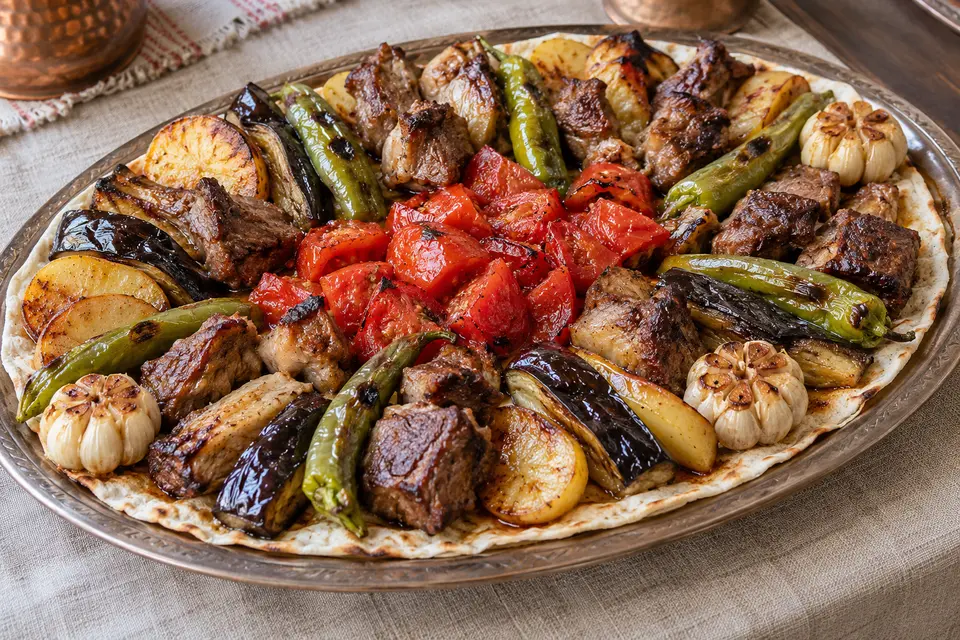
TÜRKPATENT registration No. 188 describes Tokat Kebabı as a dish once prepared for special occasions in the vineyard houses around Tokat. Its defining oven suspends skewers between fires on both sides, allowing lamb tail fat to baste the ingredients as they brown. This home-oven version preserves the registered ingredient pattern and the tomato-centred presentation, while using a rack over roasting trays to expose the skewers to strong, even heat. It is an adaptation rather than a claim to reproduce Tokat's purpose-built kebab oven.
Tokat Kebabı — Recipe Card
Tokat-Style Lamb and Vegetable Skewers on Pide
Makes 8 servingsUS cup = 240 ml · tablespoon = 15 ml · teaspoon = 5 ml. Cup and weight conversions are approximate. Australian cooks: use a 15 ml measuring tablespoon.
Ingredient quantities and servings are scaled. Cooking times, pan sizes, frying oil depth, and temperatures stay the same; cook larger batches as needed.
Ingredients
How to make Tokat Kebabı
Heat the oven and set up the trays
Heat the oven to 240°C/465°F, or as high as your oven safely permits. Set wire racks over two rimmed roasting trays. Wash all produce under running water and dry it. Keep the board and utensils used for raw lamb separate from the vegetables and bread.
Prepare the lamb and vegetables
Toss the lamb with 8 g (1 1/3 tsp) of the salt. Cut each eggplant lengthwise, then into chunky pieces about 4 cm wide. Cut the potatoes into 8 mm slices. Halve the tomatoes across their equators and place them cut-side up in the trays beneath the racks. Leave the peppers and garlic heads whole.
Build the traditional pattern
Using sturdy metal skewers, start with a small piece of tail fat, then thread potato, eggplant, potato and lamb. Repeat the potato–eggplant–potato–lamb pattern until the skewer is filled without crowding. Put any remaining tail fat near the top so it can baste the food. Thread the peppers on separate skewers and place the whole garlic heads directly on the racks. Sprinkle the remaining 4 g (2/3 tsp) salt over the vegetables.
Roast until browned and safe
Set the loaded racks over the tomato trays and roast for 25 minutes. Turn the skewers and swap the tray positions, then roast for 10–15 minutes more. The potatoes should be deeply golden, the eggplant tender and the thickest lamb pieces at least 63°C/145°F. If needed, broil for 2–3 minutes for extra browning, watching closely.
Rest and warm the pide
Move the skewers to a clean tray and rest them for 3 minutes. Lay the pide in the switched-off hot oven for 2–3 minutes, just until warm and flexible. Mash or roughly chop the roasted tomatoes in their trays, stirring them through the fully cooked pan juices.
Arrange the Tokat-style platter
Cover a large warm platter with the pide. Spoon the roasted tomatoes into the centre. Slide the lamb, potato and eggplant off the skewers around the tomatoes without breaking up the pattern, then add the peppers and whole roasted garlic heads. Spoon a little hot rendered fat and pan juice over the platter and serve immediately.
Bring this recipe to your kitchen with a printable copy.
Print recipeRecipe from MyTurkishRecipes · https://myturkishrecipes.com/turkish-lamb-and-vegetable-skewers-tokat-kebabi. Quantities reflect your selected serving scale. Cooking times are estimates; follow the doneness cues.
A few helpful kitchen notes
Traditional method
Registered Tokat Kebabı is cooked in a purpose-built oven with fire on both sides and suspended skewers. The rack-and-tray method here is a practical home adaptation that keeps the defining ingredients, skewering sequence and pide presentation.
Ingredient sourcing
Tokat peppers and Karayaka lamb define the registered regional product. Outside Tokat, use thin-skinned mild green peppers and good-quality lamb. Ask a Turkish or Middle Eastern butcher for lamb tail fat; fatty lamb trimmings are a practical substitute, though the flavour will differ.
Heat level
No added chili. The base recipe uses mild green peppers. If your peppers are hot, the finished platter will be noticeably spicier, so taste a small piece before using the full amount.
Wheat and gluten
Pide and lavash normally contain wheat, so the base recipe is not gluten-free. Do not assume a flatbread is gluten-free; check the label if adapting the serving base.
Food safety
Check several of the largest lamb pieces with a clean thermometer and reach at least 63°C/145°F, followed by a 3-minute rest. Use a clean platter and utensils after the raw lamb has been handled.
How to store and reheat Tokat Kebabı
Refrigerate leftovers in shallow airtight containers within 2 hours. Keep at 4°C/40°F or below for 3–4 days; reheat to 74°C/165°F. Store the pide separately when possible so it does not become soggy.
Tokat Kebabı: questions and answers
Can I make Tokat Kebabı without a special oven?
Yes. A very hot home oven with the skewers elevated on racks gives heat access around the food, although it cannot exactly reproduce Tokat's fire-brick oven with flames on both sides.
Why are the tomatoes roasted below the skewers?
In the traditional setup, tomatoes cook in the tray beneath the skewers and catch flavourful drippings. The home method mirrors that arrangement while ensuring the juices cook thoroughly.
Can I prepare the skewers ahead?
You may cut and thread the lamb up to 1 day ahead and refrigerate it covered at 4°C/40°F or below. Prepare and thread the vegetables shortly before roasting for the best texture.