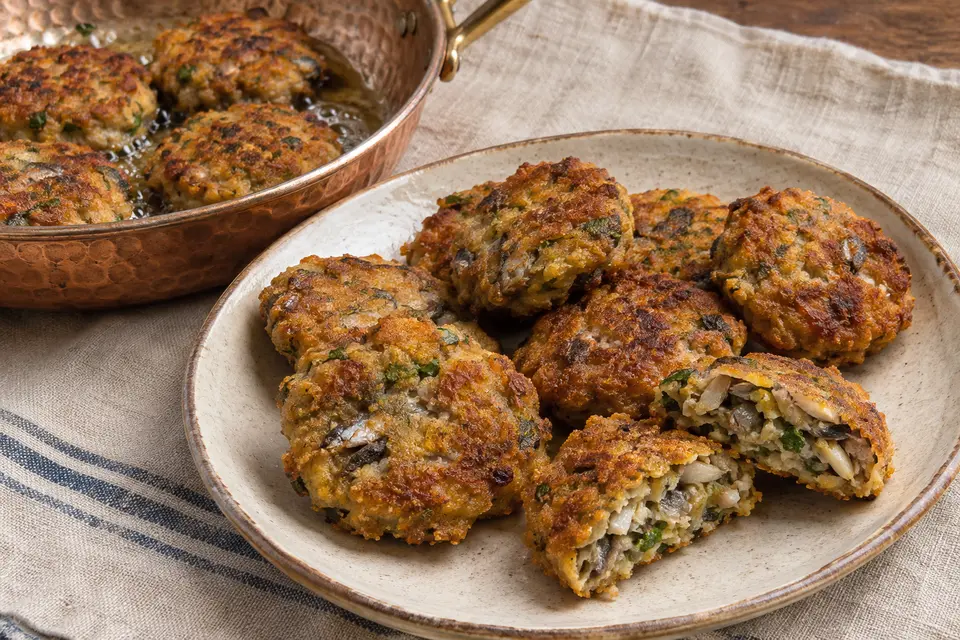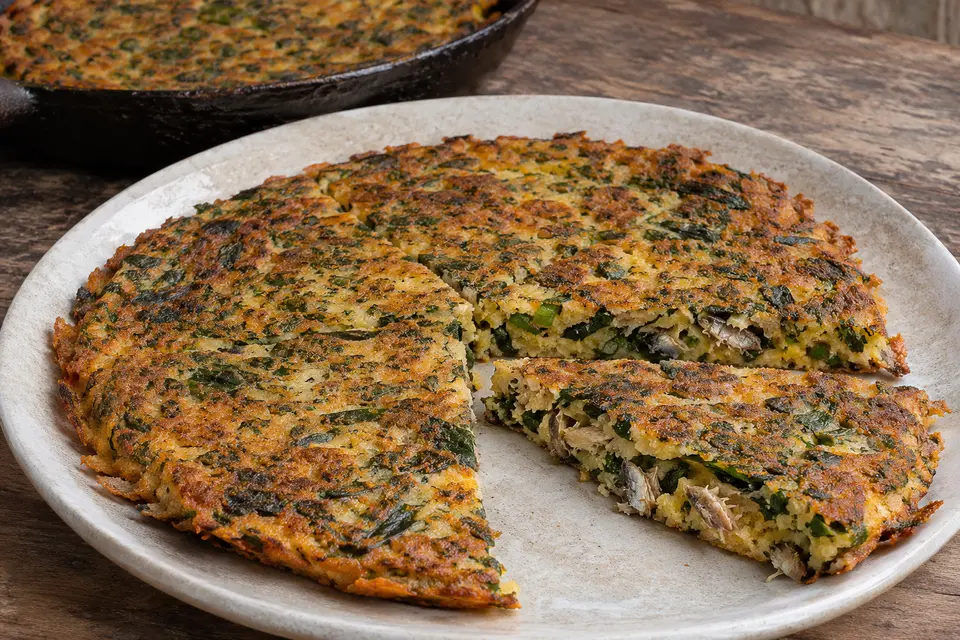
The Rize Provincial Directorate of Culture and Tourism records Hamsi Çığırtası with one bunch each of chard and scallions or local leek leaves, two glasses of fine cornmeal, a bowl of salted anchovies and an egg-sized piece of internal fat. The mixture is lightly kneaded like bread dough, spread no more than 1 cm thick and fried in olive oil or butter; small patty shapes are also traditional. Because the source's bowl measure is household-specific, this version states a practical 400 g anchovy quantity while retaining the recorded vegetable, cornmeal and fat proportions.
Hamsi Çığırtası — Recipe Card
Rize Pan-Fried Anchovy, Chard and Cornmeal Cakes
Makes 6 servings · Makes two 24 cm / 9 1/2-inch thin skillet cakes, cut into 6 wedges each.US cup = 240 ml · tablespoon = 15 ml · teaspoon = 5 ml. Cup and weight conversions are approximate. Australian cooks: use a 15 ml measuring tablespoon.
Ingredient quantities and servings are scaled. Cooking times, pan sizes, frying oil depth, and temperatures stay the same; cook larger batches as needed.
Ingredients
How to make Hamsi Çığırtası
Desalt and clean the anchovies
Cover the salt-cured anchovies with plenty of cold water for 20 minutes. Drain, change the water and soak for 10 minutes more if still aggressively salty. Remove heads, innards and backbones as needed, rinse briefly, drain very well and pat dry. Chop the cleaned fish into 1–2 cm pieces.
Prepare the greens
Wash the chard and scallions thoroughly and dry them. Finely chop the chard stems and leaves and slice the scallions or leek greens thinly. The greens must be small enough to bind into a cake rather than form long strands.
Mix the cornmeal dough
Combine the anchovies, chard, scallions, fine cornmeal and softened tallow in a large bowl. Add the egg and knead lightly. Add the warm water a little at a time, stopping when the mixture forms a thick, moist, cohesive paste that can be pressed flat; it should not pour like pancake batter.
Check the salt safely
Heat 1 teaspoon of the olive oil in the skillet and cook a teaspoon of mixture fully through. Taste only this cooked test piece. Add the optional salt to the remaining mixture only if needed; salt-cured anchovies often supply enough.
Fry the first cake
Heat a 24 cm/9 1/2-inch nonstick or well-seasoned skillet over medium-low heat. Add half the remaining oil, then press in half the mixture in an even layer no more than 1 cm/3/8 inch thick. Cover and cook for 6–8 minutes until the base is deep golden and the top begins to set. Slide onto a plate, invert the skillet over it and flip carefully. Cook uncovered for 5–7 minutes more, until the second side is golden and the center reaches at least 74°C/165°F.
Cook the second cake and serve
Repeat with the remaining oil and mixture. Rest each cake for 5 minutes on a rack or paper-lined plate so steam settles without softening the crust. Cut each into 6 wedges and serve hot or warm.
Bring this recipe to your kitchen with a printable copy.
Print recipeRecipe from MyTurkishRecipes · https://myturkishrecipes.com/turkish-anchovy-cornmeal-fritters-hamsi-cigirtasi. Quantities reflect your selected serving scale. Cooking times are estimates; follow the doneness cues.
A few helpful kitchen notes
Source measure adaptation
The official recipe uses the household measures 'one bowl' of salted anchovies and an egg-sized piece of tallow. This version defines them as 400 g and 45 g so the ratio can be repeated consistently at home.
Cornmeal version
The Rize record allows fine cornmeal or wheat flour. This recipe follows the cornmeal version associated with Black Sea cooking. Wheat flour absorbs differently and is not treated as an automatic one-for-one substitution here.
Heat level
No added chili. Hamsi Çığırtası is savory and salty rather than hot; the official ingredient list contains no pepper. Serve pepper separately if desired instead of changing the base mixture.
Allergens and dietary note
Contains fish and egg; beef tallow makes the dish unsuitable for pescetarians. Cornmeal may be processed with wheat, so no gluten-free claim is made. Check package labels and cross-contact information for your needs.
Turning the cake
A plate-assisted flip is safer than trying to toss the soft 24 cm cake. If preferred, shape the same mixture into 12 small patties, another form noted by the regional source, and fry them 3–4 minutes per side.
Food safety
Keep raw fish cold while preparing it and wash hands, board and knife after contact. Cook seafood to at least 63°C/145°F; this egg-bound version uses a 74°C/165°F center target for an extra margin and reliable setting. Refrigerate within 2 hours.
How to store and reheat Hamsi Çığırtası
Refrigerate cooled wedges in a shallow covered container at 4°C/40°F or below within 2 hours, or within 1 hour above 32°C/90°F. Use within 2 days for best fish quality. Reheat in a lightly oiled skillet over medium-low heat for 3–4 minutes per side until the center reaches 74°C/165°F. Freezing is not recommended because the chard releases water and softens the crust.
Hamsi Çığırtası: questions and answers
What does çığırtası mean here?
In this regional dish, the name refers to the thin pan-fried anchovy-and-cornmeal preparation. It is closer to a savory skillet cake or fritter than to a flour pancake.
Can I use fresh anchovies instead of salt-cured anchovies?
Fresh anchovies change the defining salty flavor and moisture balance. If used, clean and pat dry 300 g fresh anchovies and add about 4 g salt, understanding that this is a practical variation rather than the recorded Rize formula.
Is the egg required?
The regional source says egg may be added and improves the mixture. This home version includes one because it makes a large thin cake easier to turn; omitting it produces a more fragile result.
Why must the cake be so thin?
The source specifies 1 cm or thinner. That thickness lets the cornmeal and fish cook through while both faces crisp; a thicker layer can stay heavy and pasty in the middle.