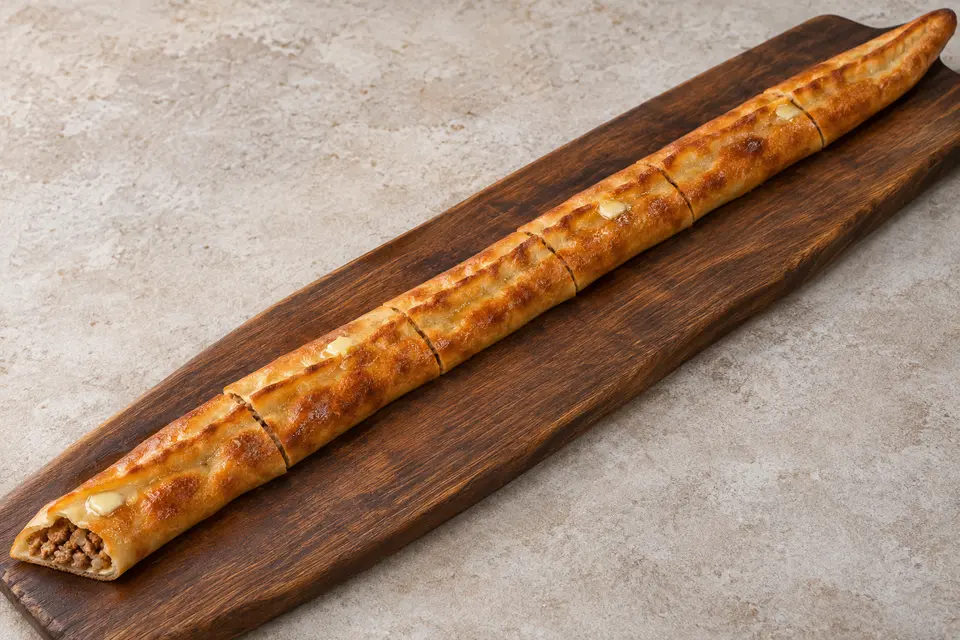
Registered in 2009, Bafra Pidesi belongs to Samsun’s distinct pide tradition. Its dough is mixed fairly firm, hydrated gradually and rested for a total of two hours. The beef is cooked and drained before finely chopped raw onion is mixed in. After baking, butter is placed inside the hot pide and brushed over the crust before it is cut into six short sections.
Bafra Pidesi — Recipe Card
Long Closed Samsun Pide with Beef and Onion
Makes 4 servings · Makes four 70–75 cm closed pides; each is cut into six pieces.US cup = 240 ml · tablespoon = 15 ml · teaspoon = 5 ml. Cup and weight conversions are approximate. Australian cooks: use a 15 ml measuring tablespoon.
Ingredient quantities and servings are scaled. Cooking times, pan sizes, frying oil depth, and temperatures stay the same; cook larger batches as needed.
Ingredients
How to make Bafra Pidesi
Start a firm dough
Dissolve the fresh yeast in 220 ml/scant 1 cup of the lukewarm water. Add the flour and dough salt. Knead for 5 minutes to form a firm dough.
Hydrate and knead
Add the remaining 50 ml/3 tablespoons plus 1 teaspoon water little by little while kneading for about 10 minutes. Stop when the dough is smooth, elastic and can be stretched without tearing. Cover and rest for 30 minutes.
Cook the beef
While the dough rests, spread the ground beef in a wide skillet over medium heat. Cook, breaking it into small crumbs, until no pink remains and the center reaches 71°C/160°F. Drain off all rendered fat and cool completely.
Finish the filling and rest the portions
Mix the cooled beef with the finely chopped onion, filling salt and black pepper. Divide the dough into four 180 g portions, shape into balls, cover with a cloth and rest for 90 minutes.
Heat the oven
Place a baking steel, stone or heavy inverted sheet pan in the oven and preheat to 260°C/500°F for at least 45 minutes. Cut four long strips of parchment to support the narrow pides.
Shape and seal
Working one at a time, stretch and roll a dough portion into a very long canoe about 1 m/39 in before sealing and roughly 2.5 cm/1 in wide through the center. Spread one-quarter of the filling in a narrow line, leaving a clean border. Bring the long edges together and pinch firmly from end to end; turn seam-side down and gently lengthen to 70–75 cm/28–30 in and 3–4 cm/1¼–1½ in wide.
Bake until crisp
Transfer on parchment to the hot surface. Bake each pide for 12–15 minutes, or two at a time if they fit without bending, until deeply golden and crisp. Check that the filling remains at least 71°C/160°F.
Butter and portion
Brush away loose flour. While the pide is piping hot, cut a short slit along the center, tuck 5 g/1 teaspoon butter inside, then brush about 20 g/1½ tablespoons butter over the crust. Cut crosswise into six 12–13 cm/5 in pieces and serve immediately.
Bring this recipe to your kitchen with a printable copy.
Print recipeRecipe from MyTurkishRecipes · https://myturkishrecipes.com/long-closed-turkish-beef-pide-bafra-pidesi. Quantities reflect your selected serving scale. Cooking times are estimates; follow the doneness cues.
A few helpful kitchen notes
Fresh yeast alternative
If fresh yeast is unavailable, use 1 g instant yeast. The small amount reflects the registered slow-rested dough; do not shorten the two-hour total rest.
Home-oven adaptation
A wood-fired black oven is traditional. A fully preheated baking steel or stone gives the closest dry, crisp result in a domestic oven.
Filling order
Cook and drain the beef first, let it cool, then add raw finely chopped onion. This is the registered Bafra method and keeps the filling crumbly rather than greasy.
Butter finish
Bafra butter is part of the registered identity. Good unsalted cultured butter is a practical alternative outside the region; add it to the hot pide in pieces rather than mixing it into the beef.
Heat level
No added chili. Black pepper provides gentle warmth; the registered filling does not include red pepper flakes or hot pepper paste.
Dietary
The base recipe contains wheat and dairy and is not vegetarian. It is not gluten-free, and no direct gluten-free variation is recommended for this long elastic dough.
How to store and reheat Bafra Pidesi
Refrigerate leftover pieces within 2 hours in a shallow covered container at 4°C/40°F or below and use within 3–4 days. Reheat in a 190°C/375°F oven until crisp and the filling reaches 74°C/165°F. Freeze cooled, individually wrapped pieces for up to 2 months; thaw overnight in the refrigerator before reheating.
Bafra Pidesi: questions and answers
Why is Bafra Pidesi so narrow?
Its registered proportions are a defining feature: roughly 70–75 cm long, 3–4 cm wide and fully closed.
Can I leave the pide open like a boat?
No. An open pide belongs to a different regional style; Bafra Pidesi is sealed along its entire length.
Should the onion be cooked with the beef?
The registered method cooks and drains the beef, cools it, and only then mixes in finely chopped onion, salt and black pepper.
Can I prepare the filling a day ahead?
Yes. Cool the cooked beef promptly, refrigerate it covered, and add the onion and seasoning shortly before shaping.