Boza belongs to a long family of fermented cereal drinks shared across Türkiye and the Balkans. The Turkish Ministry of Culture and Tourism records a bulgur version started with yogurt and dry yeast, while its İstanbul Culture Portal also documents a bulgur-and-rice version sweetened with grape molasses or sugar and served with cinnamon and leblebi. This recipe follows the Ministry's yogurt-and-yeast formula and uses the İstanbul serving tradition. Research confirms that both lactic-acid bacteria and yeast take part in boza fermentation, so flavor, acidity and trace alcohol continue to change with time.
Boza — Recipe Card
Turkish Fermented Bulgur Drink
Makes 12 servings · Makes about 3.6 litres, or 12 generous 300 ml servings.US cup = 240 ml · tablespoon = 15 ml · teaspoon = 5 ml. Cup and weight conversions are approximate. Australian cooks: use a 15 ml measuring tablespoon.
Ingredient quantities and servings are scaled. Cooking times, pan sizes, frying oil depth, and temperatures stay the same; cook larger batches as needed.
Ingredients
How to make Boza
Wash and soak the bulgur
Rinse the bulgur in several changes of cold water and drain. Put it in a large heavy pot with 2,325 ml (9 2/3 cups) of the water. Cover and refrigerate for 8–12 hours. This chilled soak is a practical home-safety adjustment to the Ministry method's overnight room-temperature soak.
Cook the first extraction
Set the pot over low heat and cook, partly covered, for about 2 hours, stirring every 10–15 minutes and more often near the end so the grain does not scorch. The bulgur should be extremely soft and porridge-like. Blend carefully with an immersion blender until smooth, then press through a fine-mesh strainer into a clean large container. Refrigerate the strained liquid while continuing.
Cook the second extraction
Return the solids left in the strainer to the cleaned pot. Add 1,500 ml (6 1/4 cups) water and simmer over low heat for 1 hour, stirring often. Blend again and press through the strainer. Combine this second liquid with the first. Let the base cool to 30–35°C/86–95°F; it should feel only gently warm.
Make the yogurt starter
In a small saucepan, whisk the flour with 130 ml (1/2 cup plus 2 teaspoons) water. Cook over low heat, stirring constantly, until it thickens, 3–5 minutes. Remove from the heat and stir in 25 g (2 tablespoons) of the sugar. Cool below 40°C/104°F, then whisk in the pasteurized yogurt until smooth.
Activate the yeast
Warm the remaining 195 ml (3/4 cup plus 1 tablespoon) water to about 38°C/100°F. Stir in the dry yeast and leave for 5 minutes. Mix it into the yogurt starter and let the combined starter stand in a warm place for 30 minutes.
Ferment the boza
Stir the starter thoroughly into the cooled bulgur base. Transfer to a very clean nonreactive container with at least 20% headspace and cover loosely so gas can escape. Ferment at a steady 20–24°C/68–75°F for 24 hours, stirring with a clean utensil every 6–8 hours. It should become pleasantly tangy, slightly aerated and thick. If it is still bland, continue up to 48 hours, checking every 6 hours.
Sweeten and chill
When the boza tastes distinctly but pleasantly tart, stir in the vanilla and remaining 425 g (about 2 1/8 cups) sugar until fully dissolved. Transfer to clean containers, cover without sealing tightly, and refrigerate immediately for at least 5 hours. The flavor continues to sharpen in storage.
Serve cold
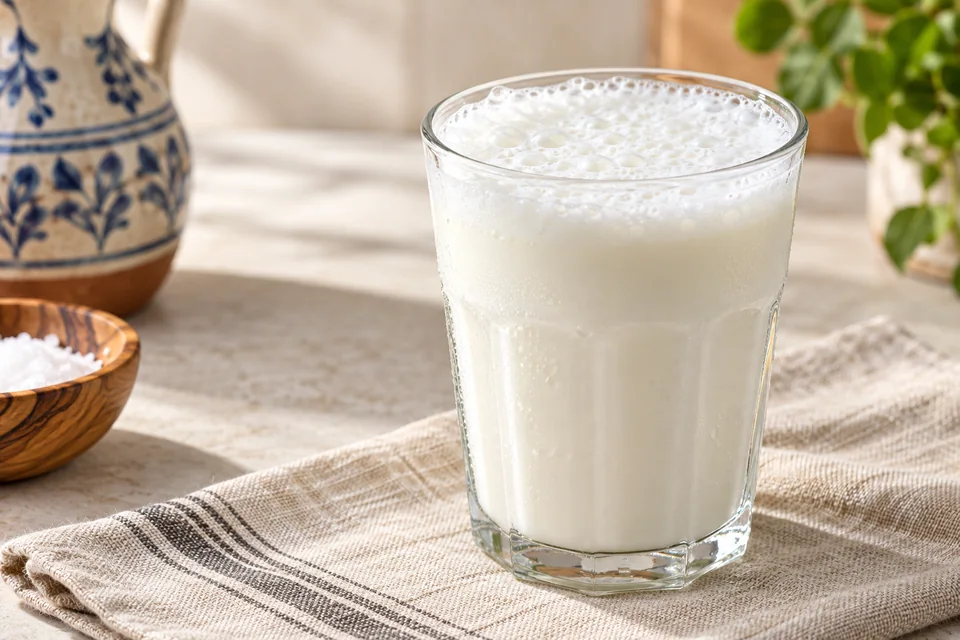
Stir the chilled boza well; thin with a small splash of cold water only if needed. Pour into glasses, dust each serving lightly with cinnamon and serve roasted chickpeas alongside. Boza should be creamy and pour slowly, not drink like water.
Bring this recipe to your kitchen with a printable copy.
Print recipeRecipe from MyTurkishRecipes · https://myturkishrecipes.com/turkish-fermented-bulgur-drink-boza. Quantities reflect your selected serving scale. Cooking times are estimates; follow the doneness cues.
A few helpful kitchen notes
Source measurements
The Ministry page prints 4,150 g water alongside 20 2/3 cups and 450 g sugar alongside 2 1/2 tablespoons; those pairs cannot both be correct with a 240 ml US cup. This recipe keeps the stated metric amounts and converts them independently to 240 ml cups. Water is divided proportionally across the Ministry's four water additions.
Fermentation hygiene
Use freshly cleaned pots, blender parts, strainer, container and spoon. Add the starter only after the cooked base cools. Keep the ferment loosely covered, never airtight, because yeast produces carbon dioxide. Discard the batch if you see mold, colored growth or smell putrid rather than pleasantly sour.
Possible alcohol
Homemade boza cannot be guaranteed alcohol-free. Research on Turkish boza found both yeast and lactic-acid fermentation and measured about 0.79% alcohol after 24 hours in one preparation; the amount varies with starter, temperature and time. Anyone who must avoid alcohol completely should choose a verified commercial alternative.
Dietary and allergen notes
The base recipe is vegetarian. It contains wheat gluten from bulgur and flour and milk from yogurt, so it is not vegan, dairy-free or gluten-free. Packaged leblebi should be checked for cross-contact if relevant. These statements do not guarantee allergen-free production.
Cereal variations
The Ministry notes that millet or barley can replace bulgur, and the İstanbul record uses bulgur with rice. Those are documented variations, but changing the grain alters thickness, flavor and fermentation behavior; do not assume the same water ratio without testing.
Sweetness
The 450 g sugar follows the Ministry's stated metric quantity. For a less-sweet personal version, begin with 325 g after fermentation, chill and taste, then add more in 25 g increments. Reducing sugar changes sweetness but not the need for proper fermentation and refrigeration.
How to store and reheat Boza
Refrigerate immediately after sweetening and keep at 4°C/40°F or below. Store in clean containers with lids set on loosely or vent once daily because fermentation can continue and build pressure. Use within 2–3 days, as stated by the Ministry recipe. Keep roasted chickpeas dry and separate. Discard boza with mold, colored growth, a putrid odor or a swollen container that cannot be opened safely.
Boza: questions and answers
Is boza supposed to be thick?
Yes. Proper boza is a dense, smooth cereal suspension that pours slowly and may be eaten with a spoon. If it is watery, the grain may not have cooked long enough or too much water may have been added after straining.
Can I skip the yogurt?
Not in this version. The Ministry formula uses yogurt together with dry yeast as the starter. Omitting it changes the fermentation culture and makes the timing and result less predictable.
How do I know fermentation is finished?
After about 24 hours, the boza should smell clean and cereal-like, taste noticeably sweet-sour and show slight aeration when stirred. If it remains bland, continue for up to 48 hours. Refrigerate as soon as the flavor is pleasantly tart; do not wait for an aggressively alcoholic or rotten aroma.
Can children drink homemade boza?
Home fermentation can produce a small and variable amount of alcohol, and the drink contains live microorganisms plus dairy and gluten. A parent or caregiver should make the decision with those facts in mind; anyone requiring a verified alcohol-free or pasteurized product should use a labeled commercial option.