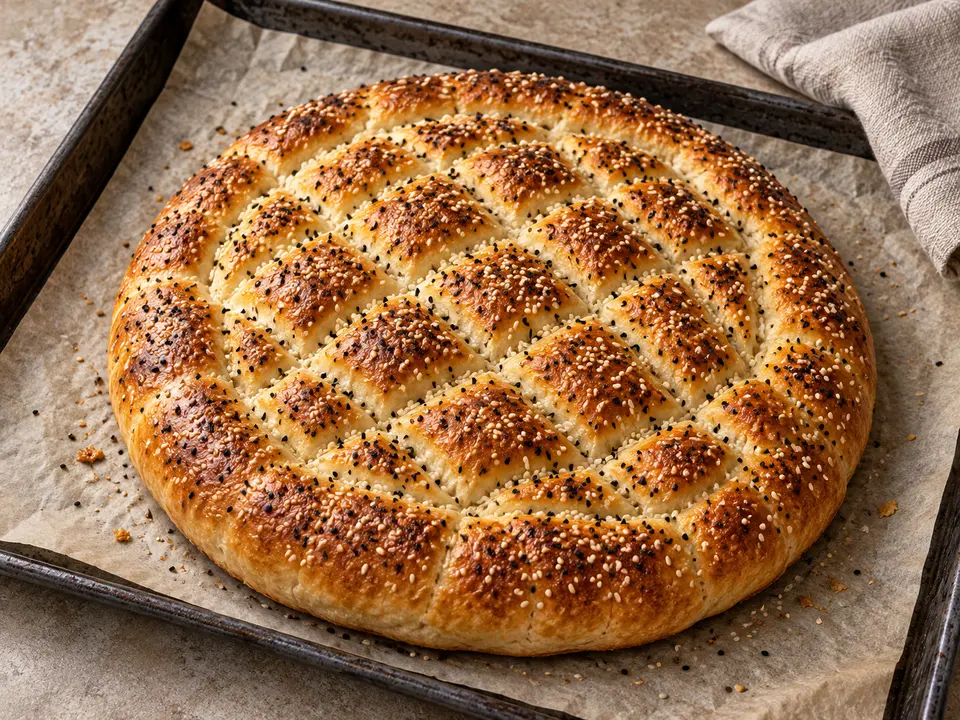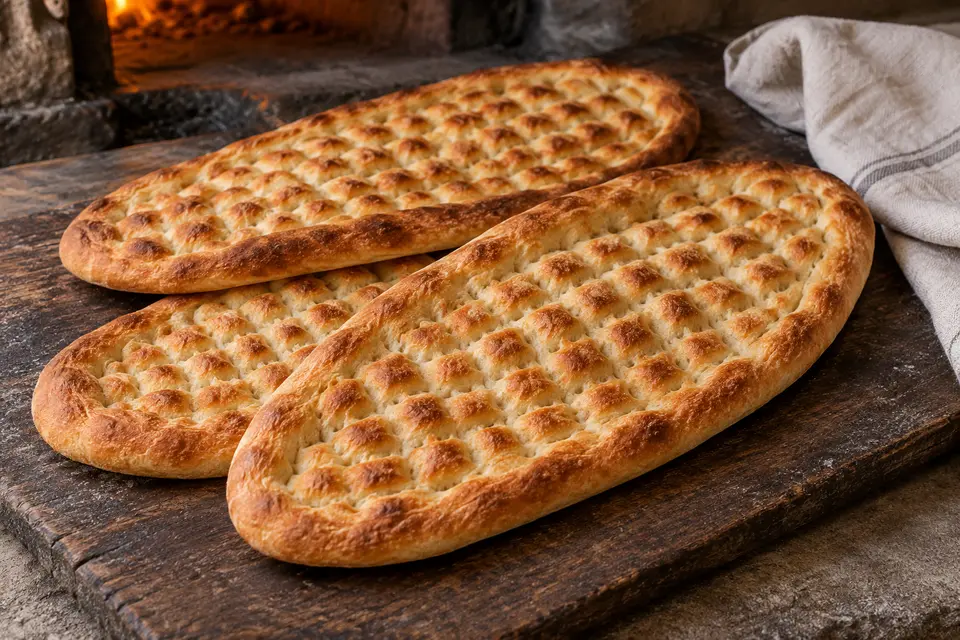
Registered as a geographical indication in 2017, Antep Tırnaklı Pidesi is closely tied to Gaziantep’s neighborhood bakeries. The protected bread is shaped by specialist bakers, marked by hand and baked rapidly on the hot floor of a stone oven; it is bought warm for everyday meals and is especially at home beside beyran, tava dishes, kebabs and dürüm fillings. The version below is an explicit home-oven adaptation rather than a claim to reproduce a certified bakery loaf. It keeps the registered bread’s basic flour, water, yeast and salt dough, its oval proportions, thin center, thicker rim and dense crosshatched tırnak pattern.
Antep Tırnaklı Pidesi — Recipe Card
Gaziantep’s dimpled stone-oven flatbread
Makes 4 servingsUS cup = 240 ml · tablespoon = 15 ml · teaspoon = 5 ml. Cup and weight conversions are approximate. Australian cooks: use a 15 ml measuring tablespoon.
Ingredient quantities and servings are scaled. Cooking times, pan sizes, frying oil depth, and temperatures stay the same; cook larger batches as needed.
Ingredients
How to make Antep Tırnaklı Pidesi
Heat the oven and baking surface
Place a baking stone or steel on the middle rack and heat the oven to 260°C/500°F, or its highest setting, for at least 45 minutes. Prepare two sheets of baking parchment or a well-floured peel.
Mix the dough
Stir the instant yeast into the 300 ml lukewarm water. Add the 500 g bread flour and the salt, then mix until no dry flour remains and a soft, slightly tacky dough forms.
Knead until elastic
Knead by hand for 8–10 minutes, using only a light dusting of flour if essential. The dough should become smooth and stretchy while remaining softer than an ordinary sandwich-bread dough.
Give the dough its first rest
Cover the dough and leave it in a comfortably warm place for 30 minutes. It should look aerated and slightly expanded; it does not need to double.
Divide and relax
Divide the dough into 4 equal pieces of about 200 g each. Form loose balls, cover them and rest for 10 minutes so they can be stretched without springing back.
Make the brushing slurry
Whisk the 15 g flour with the 45 ml water until smooth and pour the remaining 30 ml water into a second small bowl for wetting your fingertips.
Shape and tırnak the breads
Working with one piece at a time, flatten it into an oval about 20 x 39 cm/8 x 15 in and 8–10 mm/⅓ in thick. Brush on a very thin film of slurry. Leave a 1.5–2 cm/⅝–¾ in rim, then press deep, parallel rows across the center with damp fingertip pads. Turn the oval 90 degrees and repeat to form a close crosshatched grid about 1.5 cm/⅝ in apart without piercing the dough.
Bake hot and serve warm
Slide 2 breads at a time onto the hot stone or steel. Bake for 6–8 minutes, until the raised pattern is lightly browned and the base is baked but not dark. Transfer to a rack and cover loosely with a clean cotton cloth while the second batch bakes. Serve warm.
Bring this recipe to your kitchen with a printable copy.
Print recipeRecipe from MyTurkishRecipes · https://myturkishrecipes.com/gaziantep-dimpled-flatbread-antep-tirnakli-pidesi. Quantities reflect your selected serving scale. Cooking times are estimates; follow the doneness cues.
A few helpful kitchen notes
Authenticity
The registered Gaziantep bread depends on a neighborhood stone oven and specialist shaping and baking skills. This home method preserves the defining proportions and pattern but should be understood as an adaptation.
Flour choice
The registration specifies bread-making wheat flour, including Types 550 and 650. Strong white bread flour is the closest widely available choice; all-purpose flour works, but the dough may be less elastic and need 10–15 ml less water.
Dietary notes
The base recipe is vegan. It contains wheat and gluten and is not suitable for a gluten-free diet; no gluten-free label is claimed because the characteristic structure depends on wheat dough.
Raw-flour safety
Do not taste the unbaked dough. Keep loose flour away from ready-to-eat food, then wash hands, bowls, tools and work surfaces with warm soapy water after handling it.
How to store and reheat Antep Tırnaklı Pidesi
The registered bread is prized hot and is held under a cotton cloth for only about 3–4 hours because its eating quality declines quickly. At home, cool leftovers completely, wrap airtight and keep at room temperature for up to 1 day, or freeze the same day for up to 2 months. Thaw, then reheat at 220°C/425°F for 3–4 minutes. Avoid refrigeration, which speeds staling.
Antep Tırnaklı Pidesi: questions and answers
What does tırnaklı mean?
It means ‘marked with nails’ or ‘fingernail-marked.’ Bakers actually use the fleshy pads near the fingertips—not sharp nails—to press the characteristic intersecting pattern.
Is a home-baked loaf the same as the registered Gaziantep product?
No. The protected bread is tied to Gaziantep’s flour standards, skilled tırnak shaping and very hot stone ovens. This recipe is a transparent home adaptation designed to echo those features.
Can I use all-purpose flour?
Yes. Start with 285 ml/1 cup plus 3 tablespoons water, then add the remaining water only if the dough can take it. The finished bread may be a little less chewy.
Why cover the baked pides with a cloth?
A loose cotton cloth limits moisture loss while letting excess steam escape, keeping the thin breads flexible rather than brittle.